Exploring Waldorf

Teaching Reading at Madrona School

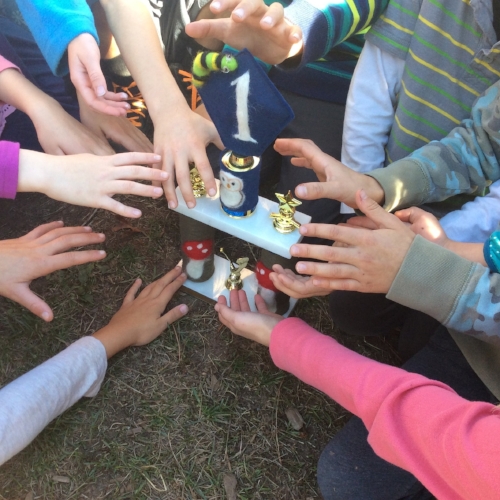
Excitement over winning the Reading Champions trophy through the public library this summer!

Excitement over winning the Reading Champions trophy through the public library this summer!

Learning to read can be a real joy and is an important academic milestone in a young student's life. In Waldorf education, we help a child's capacity for reading develop naturally, and offer lots of opportunity to fall in love with words and story.

In an ideal world, young children enjoy exposure to the world of language and literature through their parents. Hopefully, books represent beauty, humor and love to a small child -- they soak in illustrations, they giggle at funny words or at the voices an adult uses to read, they cuddle with a loved one to hear a story -- or five. Reading becomes aspirational, as they see a parent enjoy reading, or that stack of books by an older sibling's bedside. Further, in a Waldorf kindergarten classroom, a reverence for language and for story is reinforced through a daily story told by the teacher, by a ready basket of beautiful books for quiet times, and through ample opportunity for imaginative play, play that lays the groundwork for eventual understanding of abstract concepts.

In grade school, reading instruction is a part of language arts as a whole. In 1st grade, Waldorf education introduces reading through stories. Children discover letter forms out of a story their teacher tells, listening and then drawing, molding and moving through letters and their sounds. In other words, we take a multi-sensory approach, engaging a child auditorially, visually, kinetically, and at heartfelt level.They revel in the unique sounds of a letter as they practice writing simple sentences from the stories they are hearing and the pictures they are drawing. They write letters, then sentences and eventually, longer stories, until one day, it may dawn on them that they are reading what they are writing. Do you remember this eureka moment in your own life?

This unfolding and discovery allows for the love of language and of story to grow. The children work at decoding through phonics and sight word recognition too, but the emphasis remains on comprehension. Stories are told throughout a Waldorf education, and the overall literacy of a student grows with each passing year -- including vocabulary, grammar skills, and cultural and historical knowledge. With such a robust and supple beginning to language arts, Waldorf education actively cultivates space for developing capacity, both in interest and skill. Reading comes from the inside out, and while the time to master the mechanics varies, the intrinsic motivation and engagement with language is indicative of the lifelong joy of choosing to read!

For more, ask your child's teacher, or:
Read this blog post by the Waldorf School of Philadelphia, full of links to recent research in reading instruction, originally posted September 21, 2016: Reading in Waldorf Schools

For a parent's perspective, read Myth Busting: How Reading is Taught in a Waldorf School by Sarah Baldwin, Moon Child blog, originally posted June 6, 2011.

And an excellent article describing more of the art and mystery inherent in the act of learning to read: There's More to Reading Than Meets the Eye by Barbara Sokolov, Renewal, A Journal for Waldorf Education, Vol. 9#1, Spring 2000

Sometimes, reading comes along unusually slowly for children because there are underlying issues such as dyslexia.  When it becomes clear that extra help in mastering the fundamentals of reading are needed, we work with the parents to arrange for supplemental help.  Sometimes this means that a child works with a tutor at school once, twice or more times per week.  This extra help in 2nd, 3rd or 4th grade can make a big difference in a child's confidence and image of themselves as a successful reader.

Madrona School Alphabet (G)

We've reached the letter 'G' in our alphabetic journey to celebrate what makes a Madrona School education unique  ... and Graduates!

From a 1st grader's main lesson book, the beginning of a school journey...

From a 1st grader's main lesson book, the beginning of a school journey...

From time to time, we have the pleasure of checking in with some of our alumni. They truly are the best representatives of all that makes Waldorf education unique. Our graduates exhibit self-confidence and a sense of purpose in pursuing interests, in both high school and beyond. They prove well prepared for life after Madrona School!

Since 2005, Madrona School has graduated 44 students from 8th grade. The first graduating class has finished college, while other graduates are in college or high school. Initially, our alumni go on to succeed in the variety of local high school programs: Bainbridge High, Eagle Harbor, Seattle Waldorf, West Sound Academy, and Seattle Community College's Running Start program. Most of them attend college, including: Bates, Beloit College, Lewis and Clark, Canadian College of the Performing Arts, Mount Holyoke, Sarah Lawrence, Smith, Western, UW and Whitman. They are budding scientists with biology and geology majors, musicians, Spanish scholars and theater majors.

Our school home is a beginning...

Our school home is a beginning...

According to the Research Institute for Waldorf Education, and their interview-based study of 526 former Waldorf students, 94% of Waldorf school graduates attend college. Among other outcomes, their research offers three key findings about graduates, including 1) the ability to think creatively and embrace lifelong learning; 2) placing a high value on human relationships; and 3) bringing a strong sense of ethics into adulthood. We have a pamphlet in the office, entitled "The Results of Waldorf Education" with more on this research. You are welcome to come and pick one up!

Keep your eyes open to opportunities to support our current 8th grade class as they prepare for school beyond Madrona School -- we'll have a 8th grade project presentation in the spring, and graduation in early June is a wonderful evening where we are welcome to celebrate with our new graduates!

--edited from our school newsletter, February 4, 2014

Class Teachers and Building Relationships with Students

Long-term teacher-student and teacher-family relationships are a vital way a Waldorf school builds community and delivers education. Just as we see the curriculum on an arc of several years, we also value a growing and ever-evolving relationship between a teacher and a student.  

In our early childhood we achieve this with a mixed-age kindergarten where a young child gets to know their teacher (and assistants) over two to three years of time together. We are fortunate here to have an experienced and stable early childhood teaching team, and teachers who are raising their own families in Waldorf education. Our teachers offer a partnership with parents, a wonderful resource through early childhood development; where parents see their own child, our teachers see many children.

In the grade school, class teachers loop up with their students through the grades. While not necessarily unique to Waldorf education, "looping" teachers are relatively rare in American education. A class teacher has been a fixture of the Waldorf grade school since Rudolf Steiner founded the first school; Steiner believed that the strong relationship forged between a teacher and a student was essential to a robust education, and an aid to healthy child development. Our students begin each day and have main lesson with their class teacher, even while they have a chance to learn from other teachers in the specialty classes that follow. When a teacher spends this much time with his or her class, education is truly a child-centered journey, allowing a teacher to know a particular constellation of students and bring and build on developmentally appropriate and emotionally engaging education each year. Both teachers and children are engaged together in a variety of ways, and each one of them is an artist, a scientist, a mathematician, a poet and a musician, experiencing the breadth of human endeavor together; children have a chance to try on a variety of skills and disciplines on their way toward adulthood.

Relationships are fostered over many years, and class communities are built and tended through inevitable ups and downs. It is the necessary work of the teacher to know and see each student and to strive to meet them where they are developmentally. Learning to relate to one another in a constructive and loving way is essential human work, and a long-term, trusting relationship between teacher and student in a Waldorf school is one valued way we can model the importance of this.

Parent-teacher conferences are coming up -- dare we suggest that you hug your child's teacher? Talk with them, take advantage of their skill and deep knowledge of your beloved family members, speak openly about challenges and questions, and ask for what you need! We invite you to strengthen our community by celebrating the blessing of these relationships.

To read more:

Madrona School Alphabet (F)

As we continue to celebrate what makes a Madrona School education unique through the alphabet, we have reached the letter 'F' ... for Field Trips and Festivals!

Field trips take Waldorf education on the road, and many of our field trips are regular and highly anticipated additions to the curriculum.

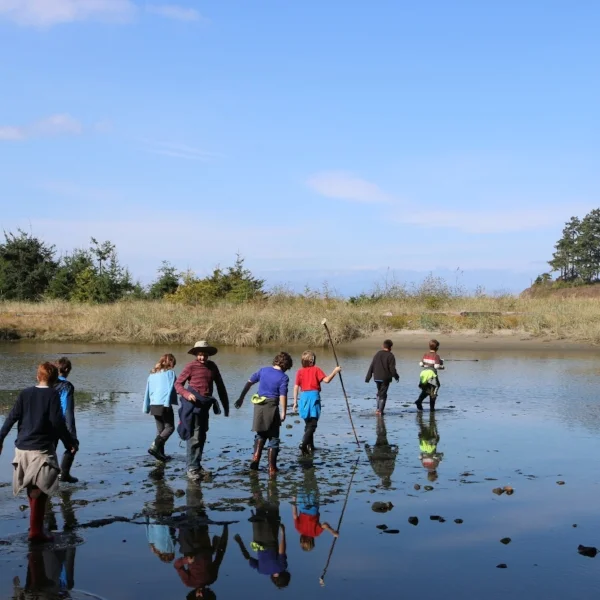
As many of you know, and your children experience, our early childhood classes are outside each week -- to Lowery Farm, as well as each Friday to other island parks and beaches. Our young students, in full weather-appropriate gear, make a colorful and energetic addition to our community, and they are able to fully engage in the outdoors in a way that is just not possible in our smaller play yards.

Many field trips are designed to enhance the grade school curriculum. They become rites of passage too -- trips to look forward to as you move through the grades. In May, our third grade will embark on their first overnight, to Pioneer Farm near Mt. Rainier, to help wrap up their year long study of the practical arts. Earlier this year, our fifth grade made a trip to the Hoh rainforest during their botany block, getting creative when their trip fell smack in the middle of the government shutdown. And our sixth grade trekked overnight to Mount St. Helens for a geology block. What natural riches we have to explore in our backyard!

And we offer trips to build community between the regional Waldorf schools, too. Beginning in fourth grade with a potlatch on Whidbey Island, our students meet with other area Waldorf schools to explore common themes from their year. In fifth grade they gather and compete in a Pentathalon; in sixth grade they participate in Medieval games; in 7th grade they enjoy a Renaissance Faire. All wonderful opportunities to spread their wings a bit, and meet other Waldorf students beyond their class communities.

Festivals are a vital part of the rhythm in our community's year. Celebrating the passing of the seasons, festivals also offer the opportunity to come together and socialize school-wide. In September, we mark Michaelmas, with a re-telling of the legend of St. Michael and the dragon, playing through challenges that remind us of our inner strength and resolve as we move into the darker and wetter time of the year. Highlights of this festival include crawling through the dragon's lair built by our 8th grade, and feasting together on potatoes from our school garden. In November, the story of St. Martin illuminates kindness and generosity to strangers, and our students revisit his story and mark the dark night with lantern walks and songs. In May we celebrate the burgeoning of spring with May Day festivities, making flower crowns and dancing around a maypole. It is a joyful, colorful end to our festival year.