Madrona School Alphabet (I)

In our alphabet-based exploration on what makes a Madrona School education unique, 'I' is for imagination -- Our students develop and nurture flourishing imaginations, making them wonderful readers, good problem solvers, flexible thinkers and in possession of a rich, creative inner life to take into adulthood. 

Preschool play

A Waldorf school curriculum highlights the importance of imagination with lots of time and room for play in early childhood, both indoors and out. Isn't it magical to see the development of a young child's play, and the richness that happens when the planning and storytelling almost become the play? A well-developed imagination lays the groundwork for academic work, as well as enhances self-discipline. 

Drawing of a fair from a 6th grade student's medieval history work.

Throughout grade school, the curriculum continues to value imagination as a part of a healthy childhood. In first grade, for example, letters and numbers are brought through story, further developing that full inner pictorial life for each student. And storytelling enhances main lessons in every grade, adding depth to the academic work. A well developed imagination blossoms again and again throughout our children's lives.

"Imagination is more important than knowledge. For knowledge is limited to all we now know and understand, while imagination embraces the entire world, and all there ever will be to know and understand." –Albert Einstein
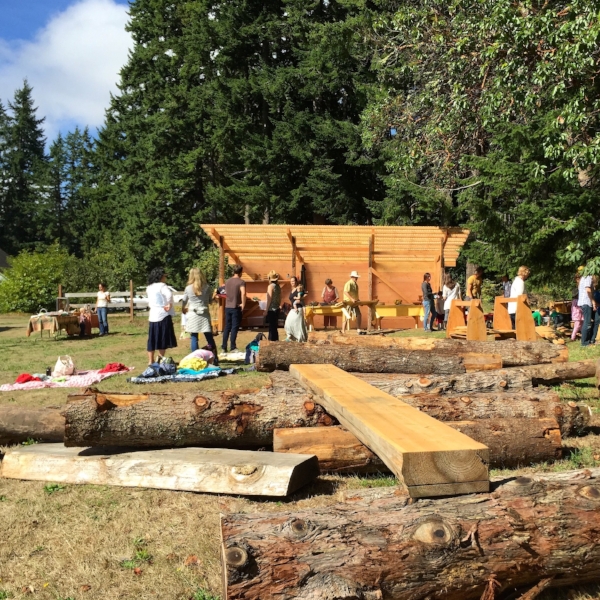
Harvest Dinner at Lowery Farm

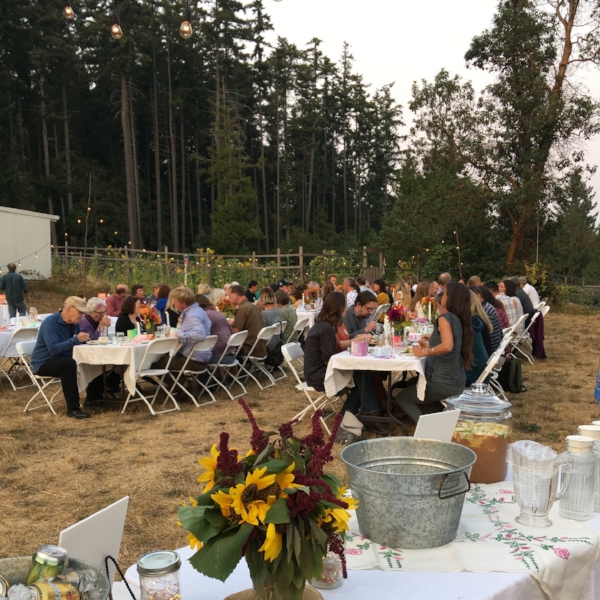
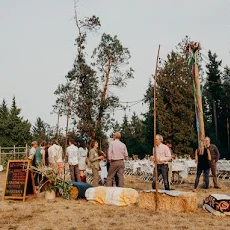
Our recent Harvest Dinner was lovely -- thank you to everyone who was able to come and celebrate the new school year with us! The dinner was a kickoff to our year-long Community Fund efforts to raise $120,000 in non-tuition income in support of our school budget. And, we've  raised $56,000 to date! We are grateful for every gift we've received and thrilled that our re-organized fundraising program is off to a strong start. If you would still like to donate, please do so through our website here. 

Enjoy these photographs from the event -- a selection from talented parents Paige Clark and Julie Rings. Thanks for sharing, you two!

Bread Day in our Early Childhood Classrooms

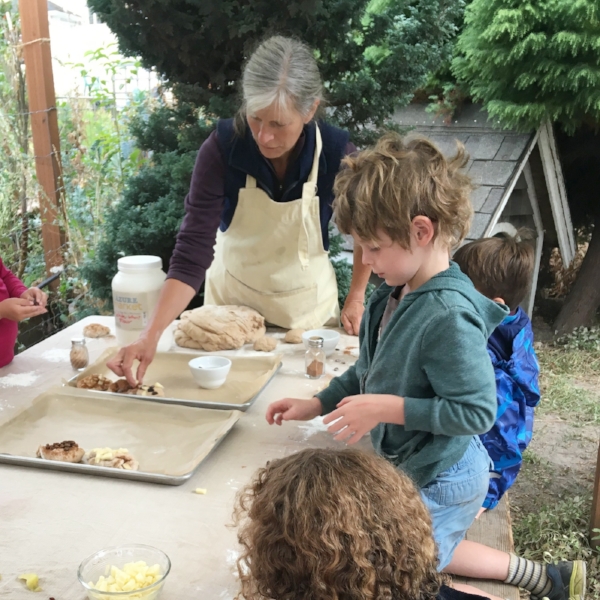
It’s baking day in the preschool. Arriving at school, the children spy the familiar cloth-covered bowl on the table. Silky, elastic dough fills the bowl and a sweet, yeasty scent hangs in the air. As each child settles in, they see their teacher reach in for pieces of dough from the bowl. They delight in taking a place at the table and receiving their piece of dough, the only invitation they need to begin kneading and shaping their bun. 

Meanwhile, the teacher sings:
Five hot buns in the bakery shop,
Big and round with honey on the top.
[Maggie] came along with a penny one day,
She bought a hot bun and she ate it right away!

The children love to hear their name in the song, and some sing out. They also join in enthusiastically when the teacher begins to chant “Pat a cake, pat a cake,...”, bringing a steady pounding rhythm to kneading dough.

When each child has kneaded and shaped their dough, and before they run off to play, they place the bun carefully on a baking sheet to finish rising. When all the children finish, the teacher slides the sheet into the warmed oven, and soon a delicious smell fills the room. Anticipation is a wonderful part of this bread day ritual, and the smell of baking bread signals the approach of the clean up song and snack time.

Finally, snack time arrives, the children waiting more patiently some days than others! On a chilly winter’s morning, the class gathers at their table indoors and lights a candle. On a a warm spring day they may walk to the park and sit together around a picnic table. In any case, the class gathers to eat their buns still warm from the oven -- made even sweeter with soft butter and jam or honey -- enjoying conversation and practicing table manners. As snack time ends, everyone washes dishes and play resumes. 

Some children routinely tuck a bit of their bun in a napkin to take home, knowing a brother or sister, or a parent, would love a little taste of bread day.

Our teachers and students engage in the preparation of a warm, organic snack each day in all of the Madrona School early childhood classrooms -- parent-child, preschool and the kindergartens. This snack fills a hungry tummy after a period of play and interaction, but it also engages many senses, such as touch, smell, sight and taste, and practice integrating multiple sensations within one experience.

Bread day illustrates our aim to engage each child's whole self at school. We surround our students with a calm, home-like environment, time outdoors rain or shine, security through daily, weekly and seasonal rhythms, opportunity for developmentally-appropriate exploration, suggestions for dress and nutrition to nourish both body and soul with warmth; opportunities for purposeful work; and an appreciation for the beauty in the every day.

bread buns.jpg


Want to add 'Bread Day' to your rhythms at home? Here is the recipe our classes begin with -- feel free to make it your own!

Madrona School Alphabet (H)

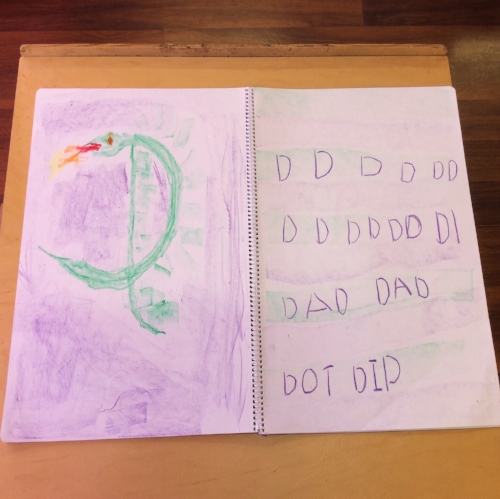
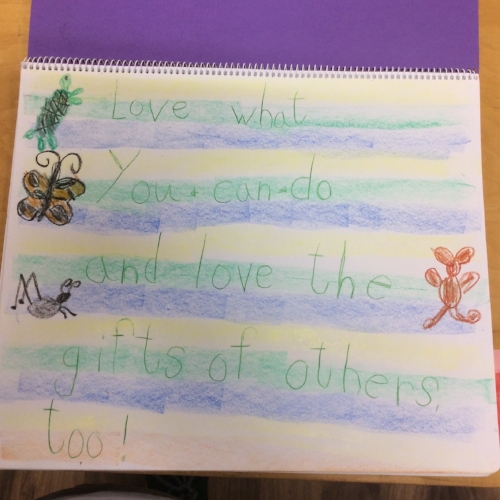
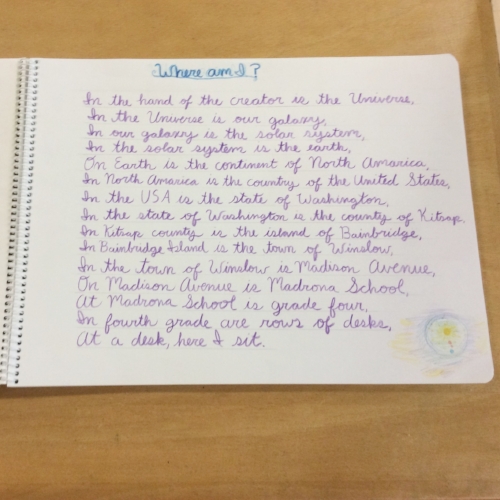
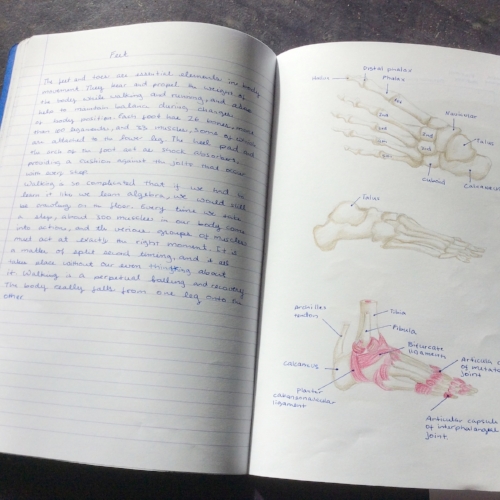
In our alphabet-based exploration on what makes a Madrona School education unique, 'H' is for handwriting -- and for the concrete beauty it adds to our work.  The Waldorf curriculum emphasizes handwriting as an integral part of the grade school curriculum. In the 1st grade, students practice writing letters as a precursor to reading. In the 3rd grade, form drawing exercises give way to formal cursive writing practice. In every year, each student collects their work into their unique and beautiful main lesson books, the previously blank pages filling with examples of their paragraphs, poetry, essays, observations and drawing. Recent research reveals how handwriting helps children learn, by improving cognitive development and hand-eye coordination, and strengthening reading through better letter recognition. It lays a foundation for effective note-taking and communication for life. At Madrona School, we write before we type.       


Looking Towards Our Future: Lowery Farm CUP

In a letter sent out to our school community on May 24, 2017, we were excited to announce that we've cleared one step in the process towards a new campus. This represents a lot of work on the part of many, and we are grateful! As we've lived in to the Lowery Farm property a bit over the last few years, we've grown to love the land and what it might represent for the future of our school. 

Dear friends and fans,

I am delighted to report that this morning we received the Hearing Examiner's favorable judgement on our CUP application.  As you can read below, Phases I and II of the project have been approved (with a host of conditions, most of them exactly as we had expected) and with phase III being "remanded to the City for further investigation of the traffic impacts of the operation of the proposed auditorium." 

We were particularly pleased to be acknowledged in a couple places for our thoughtful design:
"The Hearing Examiner takes notice that schools are more often than not located in residential areas.  The plans presented go to considerable length to assure that during normal hours the new school will fit in.

The proposed school development is part of an overall pattern of growth.  In the larger development picture, the school actually represents the retention of open space, as compared with standard residential development.  92.5% of the property will remain open.  This applicant, a Waldorf school, is particularly sensitive to concerns for preservation of natural conditions because nature plays an important role in its instructional program."

Thank you to all of you who have supported this (lengthy) application process! You wrote letters that became part of the testimony considered by the examiner; you attended meetings; you spoke up in favor of this project.  I hope that you feel as pleased about this as we do!

I will be communicating more about next steps soon.

Sincerely,
Missi, on behalf of the board and campus committee
 

Read the Hearing Examiner's ruling in its entirety here!

Unpacking the Stump Project

stump.jpg

Teacher Isaac recently wrote to his families:
Some of you might have noticed the digging project that the kindergarteners began, several weeks ago, around the roots of the old Douglas Fir stump on the play yard. The project grew from a simple question, "I wonder if we could tunnel under that root?" "Hmm... I wonder..." was the reply. The curiosity was contagious and the picks and shovels have been busy ever since.

Now, I'll be the first to acknowledge my own enthusiasm for the project. I too wonder what might lie buried below. (In fact, I forget who posed the original question, and suspect that it could have come from me.) Fortunately for big projects such as this, enthusiasm is contagious and the children will come and go throughout the course of any morning. Some will jump into the holes and move the earth right alongside me. Others will help push and pull a wagonload of dirt from here to there. Still others come to step and leap from root to root, observing the progress and creating their own imaginations.

However, once the work is underway, I like to take a step back and spend a moment observing (with wonder) the many layers of work going on around me.

The children moving the earth with shovels and hands are meeting a variety of resistances as they tunnel through dirt, sand, rock and clay. Their developing proprioceptive system is being stimulated and strengthened with every scoop. Others crawl beneath roots and squeeze through narrow openings. The nerve endings concentrated in the joints receive input from these gross motor activities (like shoveling, pushing, pulling, carrying heavy objects, etc...) that gradually builds an internal map of one's body in space. They are discovering themselves by coming up against the earth.

I see that some of the children try to avoid touching the mud or dirt or sand with their bare hands. I make note that they may be more touch sensitive than their peers, and I try to find opportunities to introduce new sensory input to these children and encourage them to play in a way to help them integrate this developing sense.

The children who are balancing on the latticework of exposed roots are strengthening their core muscles as they work to stay upright, as well as working the vestibular system of the inner ear. Others are hanging upside down or reclining in a hollow. As the fluid of the inner ear sloshes back and forth with the movement of the head (especially upside down!), there is again the gradual inner mapping of the spatial planes and the body's relationship with them (front, back, side to side, up and down). Having these activities available for the young child is important for their developing sense of balance and sense of movement.

Of course, the children care nothing for such adult talk. They instead are pirates, ninjas, otters, cats, birds, princesses and knights. They are making homes and forming relationships and discovering more mystery in the ordinary than we could ever imagine.

Together, the children and I, vigilantly watch each shovelful of dirt and rock for unearthed treasure. We wonder how deep we can dig, how much earth we can move, and if anyone will fit between the roots we have exposed. The fun is in the wondering of the question and in the application of the will to try to answer that question.

With enthusiasm,
Isaac

What began as a Salmonberry kindergarten project, has captured the imaginations and will of children of all ages!

Community Eurythmy

We are happy to welcome Audun Smit back to Madrona School for the month of March!  In addition to teaching kindergarten - 8th grade classes, he will be offering community Eurythmy on Fridays at 9:00 - 10:00am in the Eagle Harbor Congregational Church Fellowship Hall at 105 Winslow Way W on Bainbridge Island.  

We hope that you will be able to join us for this rare opportunity to do Eurythmy with an inspiring young teacher.   RSVPs to the school office, 206-855-8041, would be nice, but are not required.  We have Eurythmy shoes or bring your own.

No previous experience is necessary.   Bring a friend! 

Move your body - touch your soul.

Teaching Handwork at Madrona School

To create something with one’s own hands, if only once in one’s life, is surely a healthy antidote to becoming a passive consumer. –Michael Howard

Handwork is one of the unique specialty classes offered in a Waldorf grade school. At their most basic, the classes teach respect for simple tools: needle & thread, sticks and string, the spindle, wool, a knife, and of course, our hands. Handwork classes bring joy, teach practical skills around real work, and offer every student the opportunity to create beauty, along with the intrinsic satisfaction of completing an often long-term project.  

Developed to work in tandem with the curriculum as a whole, handwork strengthens fine motor skills and helps with hand-eye coordination, which in turn help students with writing, reading and math. Knitting, crochet, clay, woodcarving, embroidery etc., all contribute to the formative artistic foundations found within a Waldorf education, fostering creativity, flexibility and independence. 

Michael Howard, a Waldorf educator, and author of Educating the Will, writes extensively about what handwork classes offer our students, and he takes it further with spoon carving as his example, saying, “We must seek every opportunity to develop the feeling will [or an artistic sense or feeling] because the capacity to feel the clumsiness of our spoon and to intuitively feel, step by step, how to make it harmonious is not limited to spoon making. As our feeling will awakens through activities such as the arts and crafts, it will become active in other domains such as social life. …Our feeling will awakens our creative will to be social sculptors who transform dead and chaotic social forms into more living and harmonious ones.” Handwork classes speak directly to a main educational goal at Madrona School, the nurturing and teaching of whole human beings, capable of shaping their own lives beyond the classroom.


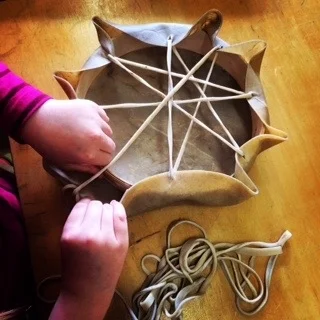
What are the handwork curriculum basics here at Madrona School? Our kindergarteners often do a bit of whittling and hand-sewing to create little pocket gnomes (see above), or dolls, but the program begins in earnest in 1st grade with knitting. In second grade, they add to their knitting skills and begin crochet. In third grade, they expand their crochet abilities, and experiment with taking a fleece through washing, spinning and weaving. In fourth grade, they learn basic embroidery, as well as designing and stitching a cross-stitch piece. In fifth grade, it’s back to knitting, this time in the round, making socks. In sixth grade they play with taking two-dimensions into three-dimensions, designing a stuffed animal, first on paper, and then hand-sewing their creation. In seventh and eighth grade, we often expand into working with different materials, including woodworking, carving soapstone, metal work and expanded embroidery techniques. The eighth grade also spends some time with machine sewing, making quilts and clothing. In addition to all of these skills, our students experience other crafts within their main lesson blocks – making drums or cedar baskets in4th grade Native American and local history studies, or stained glass in a 6th grade Middle Ages block.  The breadth of these opportunities adds further dimension to our arts-integrated academic curriculum.

Finally, handwork classes offer students a way to see form made visible. If you’ve had a first grader in our program, you’ve seen the loosely-knit first projects transform through further practice into a second project – often a flute case they can use for years – where the stitches even out and mistakes are seen and fixed. These lessons in learning to see their work echo observational skills grown throughout school, in experiment-driven science classes, in social relationships, and in an awakening self-awareness. Handwork classes ultimately contribute to a healthy confidence our graduates take with them into the world. 

--edited from our weekly school newsletter, February 14, 2017