grade school

Madrona At Home

Hello to you all from our bedroom offices, our couch classrooms and our kitchen science labs! We wish you good health and lots of rest. We miss our in-person community very much and we look forward to a time in the near future when we can gather together in our classrooms and as a school. In the meantime, Madrona School is continuing to offer learning materials and community through our program, Madrona At Home. Please reach out if you have any questions or concerns — we are always happy to hear from you!

Our head of school, Deborah Newlen shared the following in our newsletter after our first full week of COVID-19 related closure:

A Few Madrona at Home Tips for Families From Deborah

As we all live into our new shared experience, we can discover what works and supports us and our children. What follows is my list of tips based on the last week of alternate reality. Please feel free to email me with your ideas and we will include them in next week’s newsletter. It would be great to have the “Madrona Brain” transcend sharing in individual classes and represent community wide thinking.

  • Absolutely get outside for an hour a day, especially if you are spending more time at the computer than is normal.

  • Take a bath with Epsom salts and/or an essential oils.

  • Do something to distinguish down time from “on” time and remember to still create dedicated personal and family time that is not about work or school or specific responsibilities.

  • Check out the many museums online that have posted some or all of their collections because of the coronavirus.

  • Write a physical letter to someone you care about.

  • Notice that it is glorious spring; nature’s shelter in place season has passed.

— edited from our weekly newsletter, March 24, 2020

Madrona School Alphabet (U)

‘U’ is for Madrona School’s unhurried approach to beginning school. Our youngest students attend Madrona with their parents or caregivers as a part of our parent-child program. This unique once-weekly class allows children a gentle, warm and nurturing introduction to school as a social setting outside of their homes, and it provides a community for their caregivers too. We offer a warm snack, lots of time to play with our open-ended and natural toys both indoors and out, a circle time with songs and story and some parent education. It's a mini-version of our preschool and kindergarten classes, in effect, and serves to introduce families to Waldorf education, as well as support them in creating a rich, nurturing home environment. As a parent, you'll find yourself learning songs for transitions that you'll still sing years later! This class is also often the beginning of a class community , and some of our grade school students (and their parents!) "met" in parent-child.

Madrona School Alphabet (T)

‘T’ is for Waldorf education's unique approach to technology with a purpose — both in the classroom and in our children's lives. This is one area that certainly gets a lot of attention in the mainstream media, especially in the aftermath of the New York Times article published in October of 2011, "A Silicon Valley School that Doesn't Compute". Search for 'Waldorf education' and you find a slew of articles on Waldorf schools' purposeful lack of information technology in the classroom. It is a highly visible difference in choosing a Waldorf school over your other education options. However, the articles don't tell the full story. We do use technology in our curriculum, but always with a purpose. We approach technology in the same way we teach everything -- in a developmentally appropriate and contextual manner. Our grade school curriculum is an experiential one, building from year to year, as children become ever more capable and developmentally ready to learn, to do, to write, to read, to think. The curriculum develops deliberately, teaching hand sewing and knitting before machine sewing; printing and cursive writing before keyboarding. Computers and other information technology are introduced in their historical and cultural context, as part of a study of the modern era. And yet, by the time our middle schoolers graduate, they should be able to type and turn in word processed assignments; they've learned how to do quality research online and effectively use a library. Most importantly, they understand technology in the context of the human experience, and they tackle new elements with their characteristic flexibility and creative approach to problem solving. As you are no doubt aware, there is a growing body of research into the effects of screen time on the development of the young child. And, even beyond the profound benefits of reducing a child's exposure to screens and commercial media, the Madrona School curriculum aims to teach foundational skills to allow for the full blossoming of each individual's creativity and flexibility of thought: writing with pencil and paper and organizing one's thoughts onto the page, drawing, math facts without a calculator, etc. And in this ever evolving technological world we live in, creative problem solving and a strong sense of one's ability to tackle new issues will prepare our students well as they move out into the wider world.

— adapted from our school newsletter

Madrona School Alphabet (S)

The letter ‘S’ highlights the unique way in which Waldorf education honors the human spirit. In Waldorf language, we say we educate "the hands, the heart and the head", referring to the curriculum's reach to the doing (our hands), the feeling (our heart) and the thinking (our heads). We strive to honor and recognize (rather than instruct) each child's soul, each child's developing inner life, as they grow and mature, as well as those of our classmates, our teachers and the cultures and civilizations that we study throughout elementary and middle school.

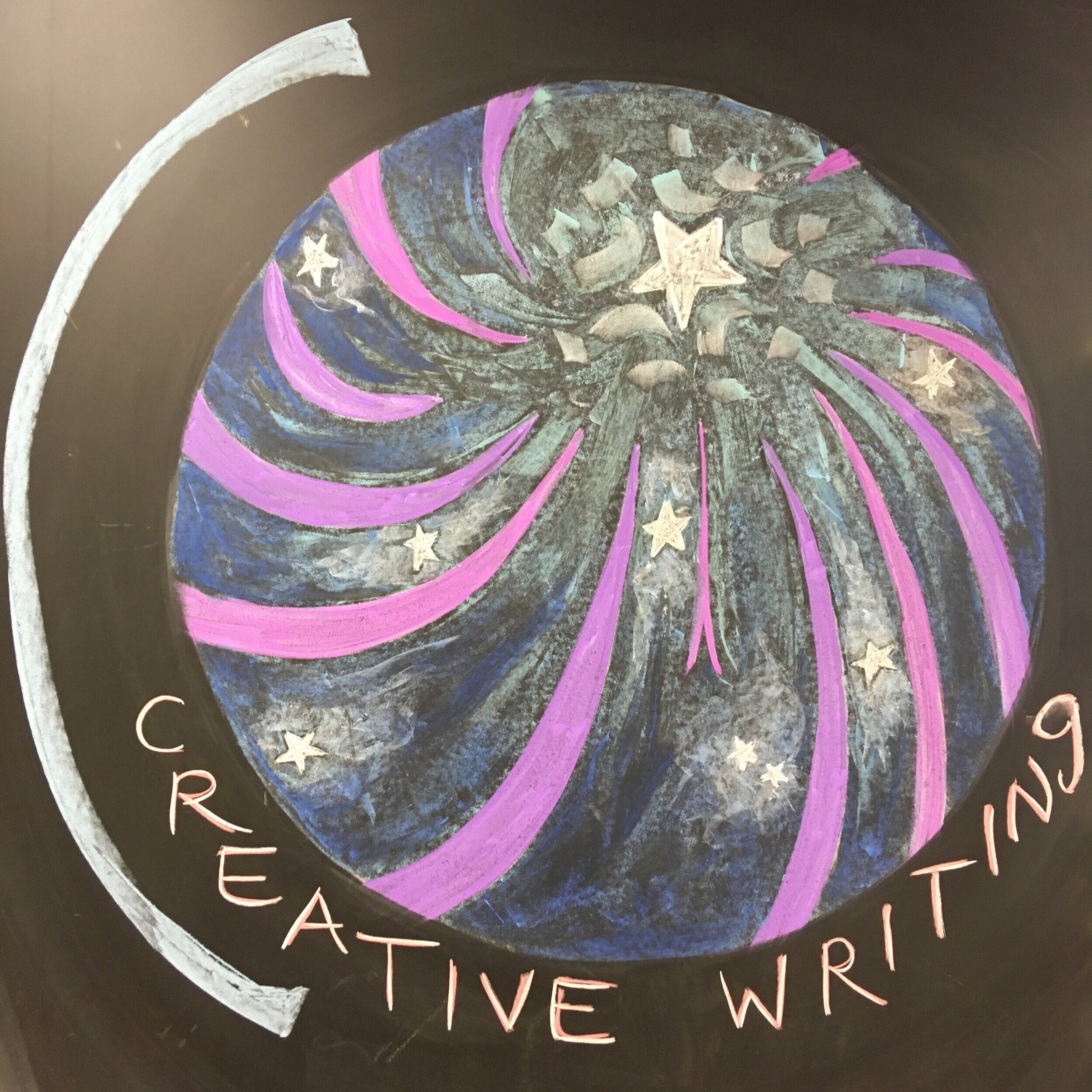
Chalkboards from the grade school classrooms in 2019.

Embedded in this liberal arts non-parochial education is a profound sensibility that there is a spiritual element to our humanity, and an innate capacity in all of us for reverence and wonder. What does this recognition look like on a daily basis? In his book, "The Way of the Child", AC Harwood writes: "It is perhaps this life of feeling, this soul life, which is least understood in education today. We instruct our children in the classroom -- or in the more modern fashion we allow printed books to instruct them -- and then when they are tired we send them out to play games. But between knowledge and activity lies a whole world of wonder and reverence, pity, joy tenderness and sorrow….Everything they learn must be transformed into wonder and beauty, there must be no 'ordinary' lessons. Painting, modeling, acting, rhythmical movement, these must become for these young children the very way of knowledge. If you succeed in teaching in this way, you are uniting what is nowadays divided -- the forces of the head with the forces of feeling and of movement."

There is an element of mindfulness in the way we begin each morning. The grade school children begin each day with a morning verse, calling out for strength in body, mind and spirit. For example, in 1st through 4th grades, they stand and say together: "The sun with loving light, makes bright for me each day. / The soul with spirit power, gives strength unto my limbs. / In sunlight shining clear, I do revere, Oh God, the strength of humankind that thou hast so graciously planted in my soul. / That I with all my might, may love to work and learn. / From thee come light and strength, to thee rise love and thanks." God, as referred to in this verse, can stand for those higher aspirations we all possess, including honor, truth, beauty and nobility. This moment is just one way we offer a sense of reverence, a call to purpose in order to begin the day.

And, by the time a student graduates the 8th grade, they've not only spent years honoring their own inner life, but they've also learned something about the religious and spiritual traditions of Buddhists, Jews, Christians, Muslims, Hindus, and many other cultures around the world. This reinforces the basic humanity of our soul life, the importance of being fully human and alive.

This is, of course, a glancing skim over this topic in Waldorf education. But, at the core, what a gift it is to honor a child's spirit, to help them to grow with the full recognition of the importance of their own humanity, and the necessity of respecting that of people around them -- truly something wonderful to take into adulthood.

If you are curious to learn more, please talk with your child(ren)’s teacher(s)!

— adapted from our school newsletter

Madrona School Alphabet (R)

‘R’ is for recess at Madrona School. Enough said, really.

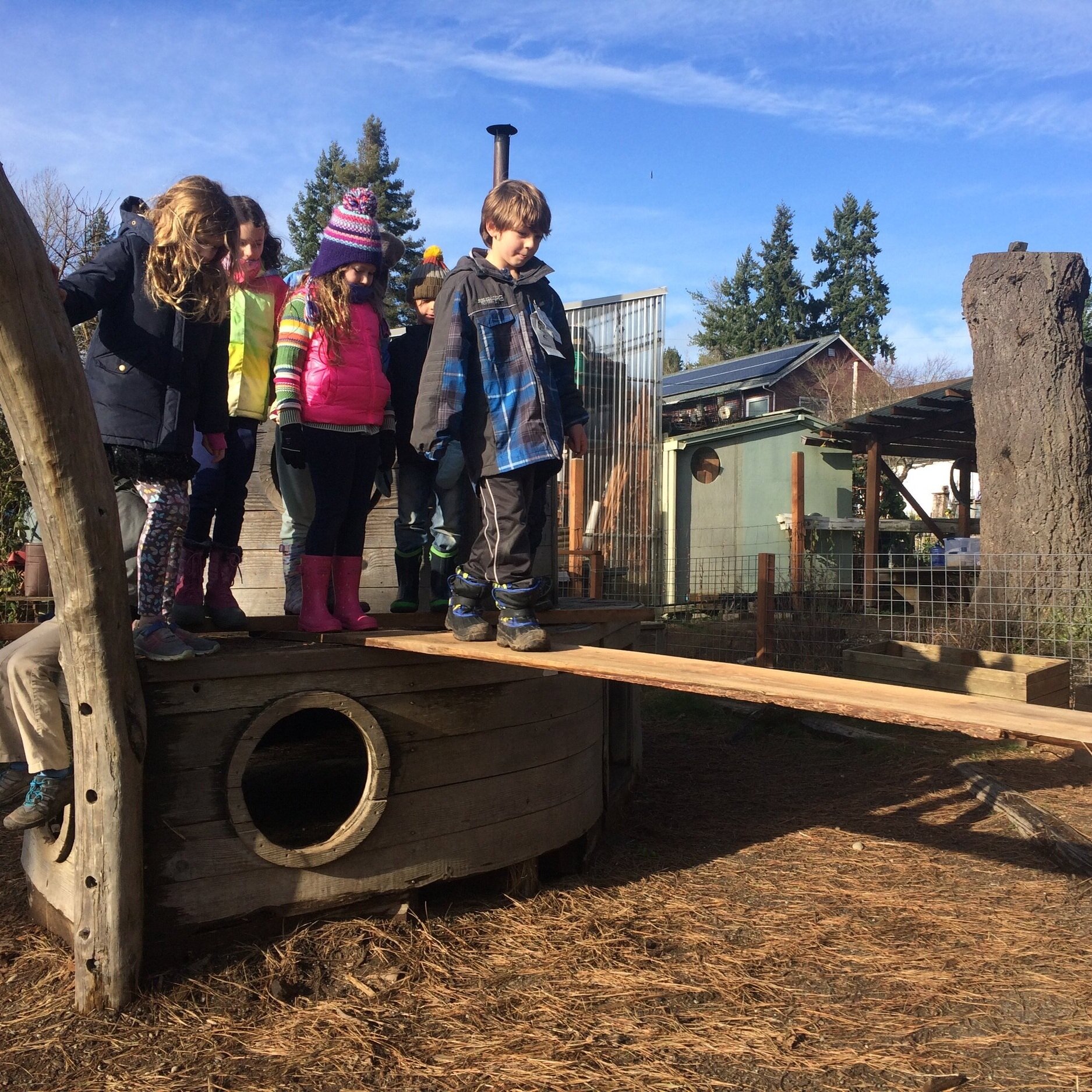
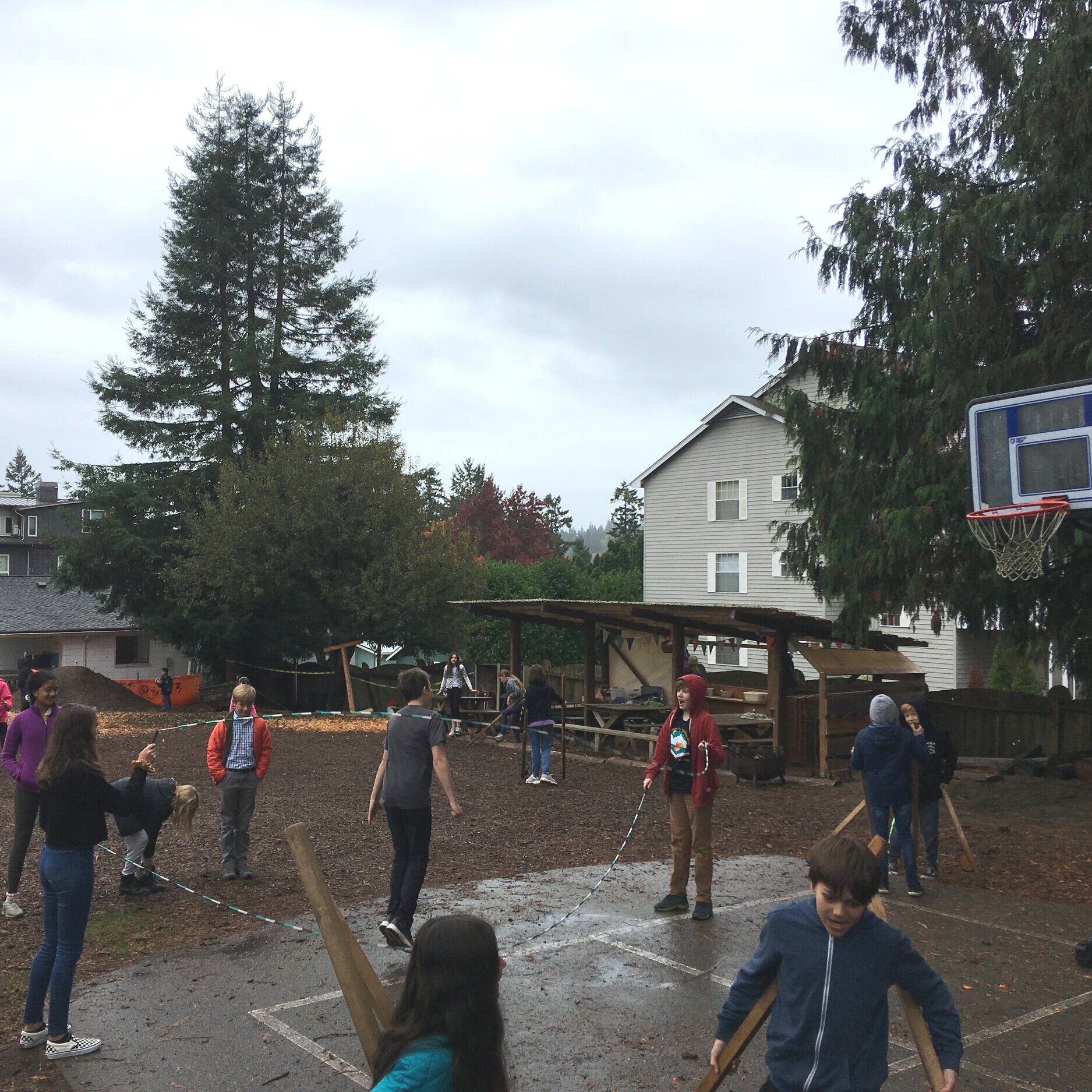
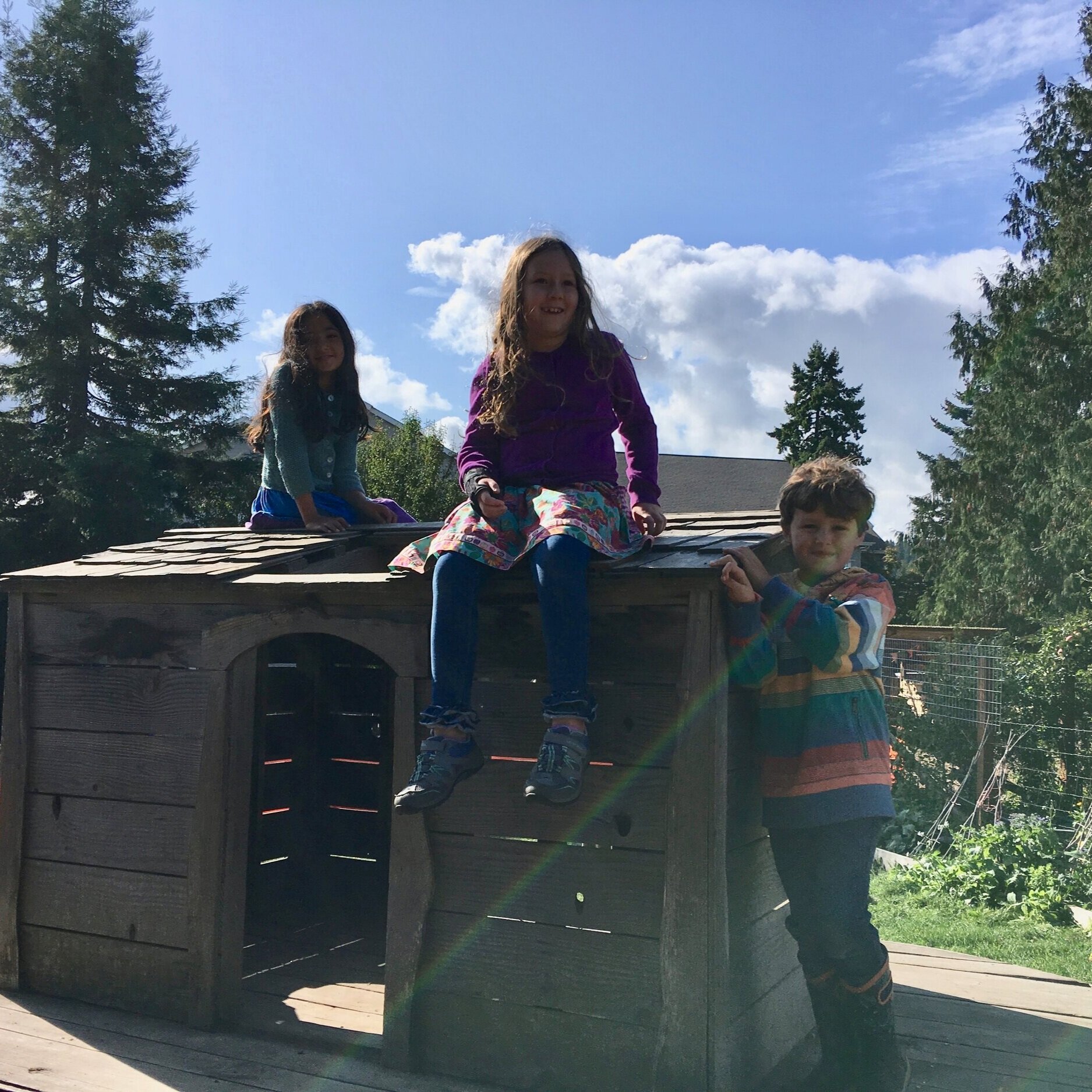
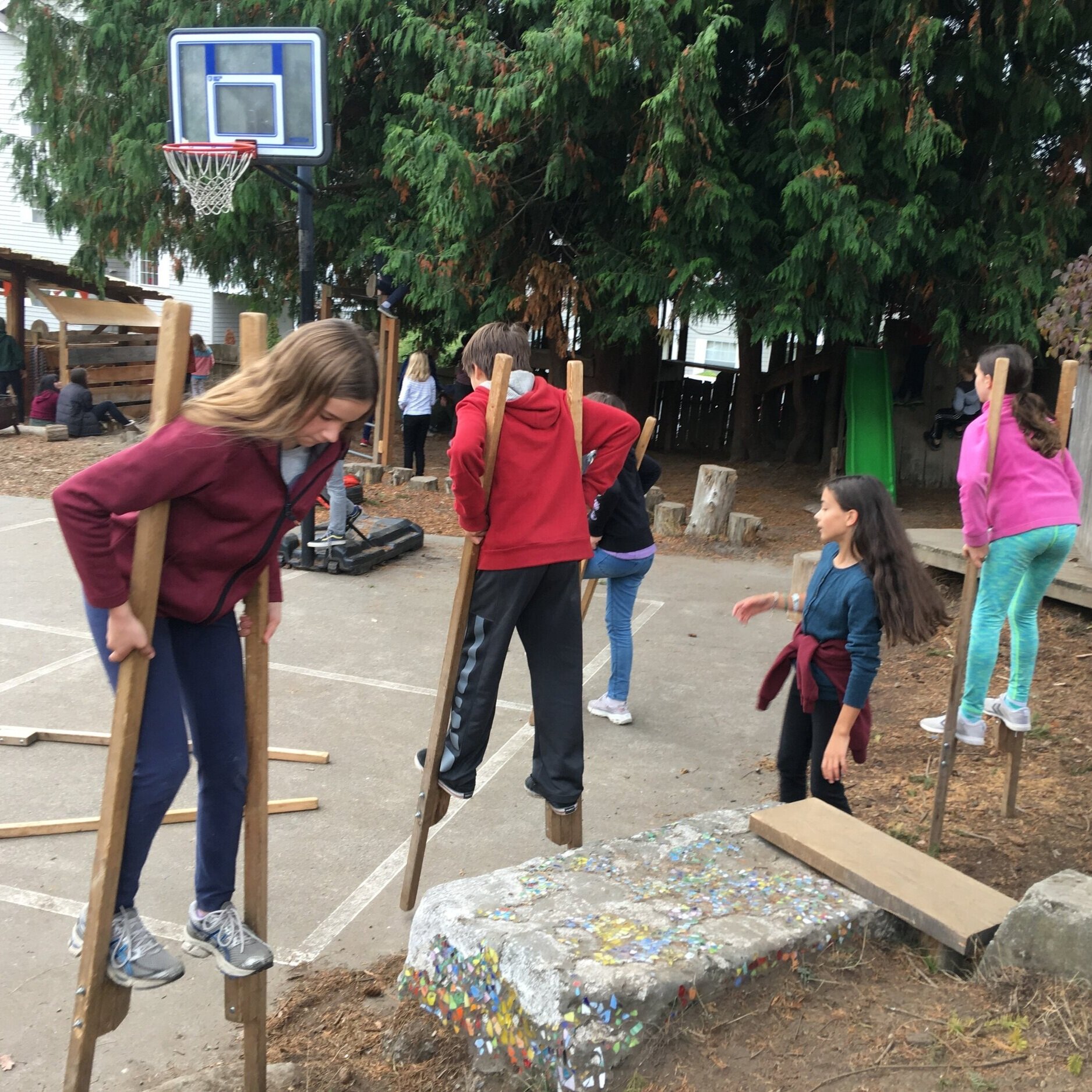
Students of all ages at Madrona School really know how to do recess well, and it is a natural outgrowth of the emphasis on outdoor play in our early childhood program. In our grade school, all of the classes go out to the play yard after morning snack and after lunch. The grades mix and there are many, many games in progress at any one time. The children play four square, basketball, dodgeball, tetherball, "squirrel tag", jump rope, turn cartwheels, dig moats, swing from the monkey bars, and congregate in the apple trees or on top of the ‘ark’ to chat. They even get some non-tackle football in with a game someone dubbed "catch ball". Always supervised by three teachers or office staff, it is a joyful and inventive time, an opportunity for blowing off steam and getting those extra wiggles out before returning to the classroom. And, middle schoolers have a chance each week to have their own recess at Waterfront Park, for that big-kid-off-campus time they so want at their age.

When we give tours to prospective grade school families, we often walk through the hallways as morning recess is in progress. Many parents comment on our two recess periods rain or shine, on how our grades play together, and on the natural setting that our children enjoy. Recess can really show off the sweet, natural, and community nature of our school.

— adapted from our school newsletter

Madrona School Open House -- Join Us!

The whole family is very welcome to join us on Saturday, January 11 between 10am and 12pm for our annual school-wide Open House. Come meet teachers and see classrooms. We’ll have information available on next year’s early childhood programs and we are eager to show off work and teachers for grades 1-8 too! Bring a friend or neighbor — this is truly a “more is merrier” morning at school. Hope to see you there!

Madrona School Alphabet (P)

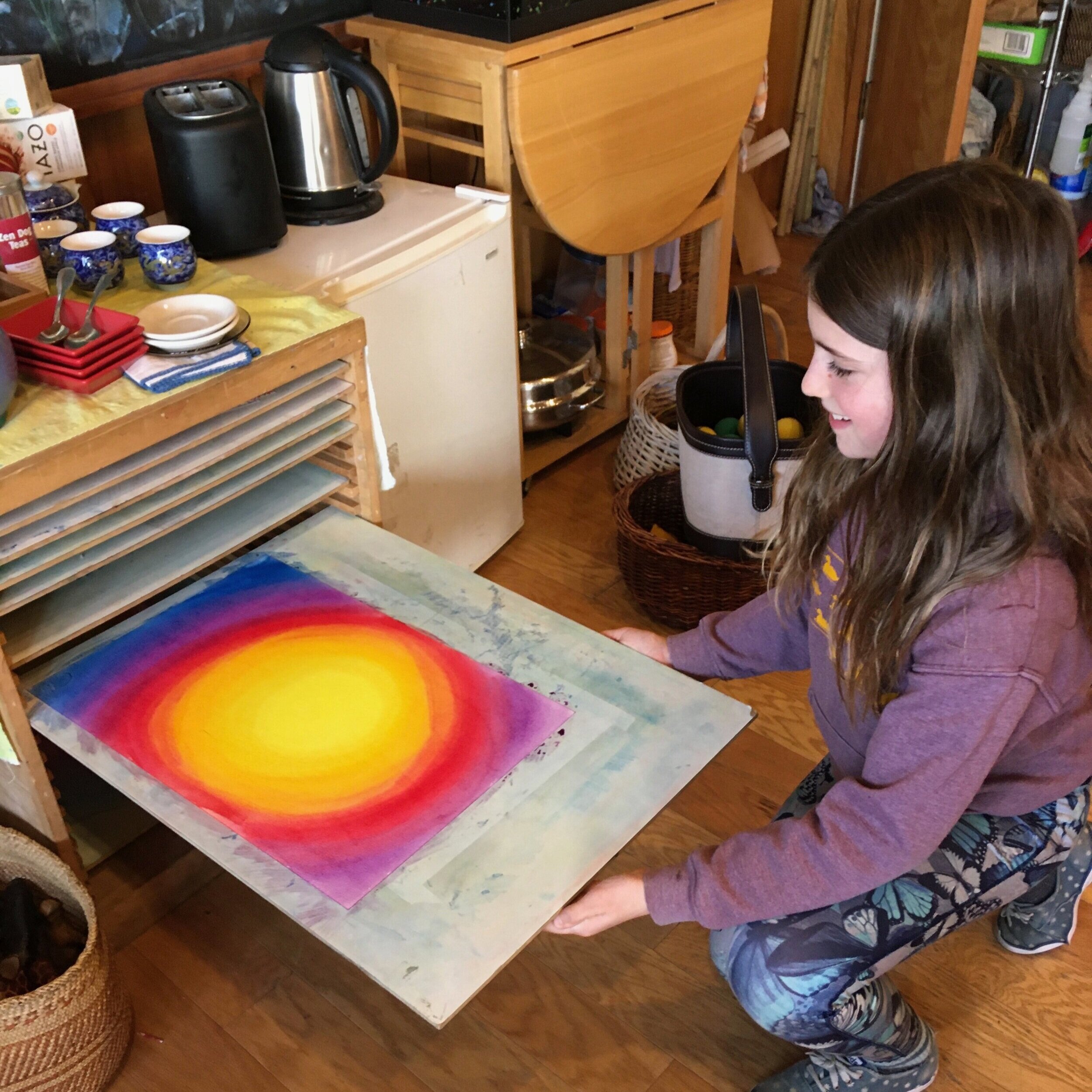
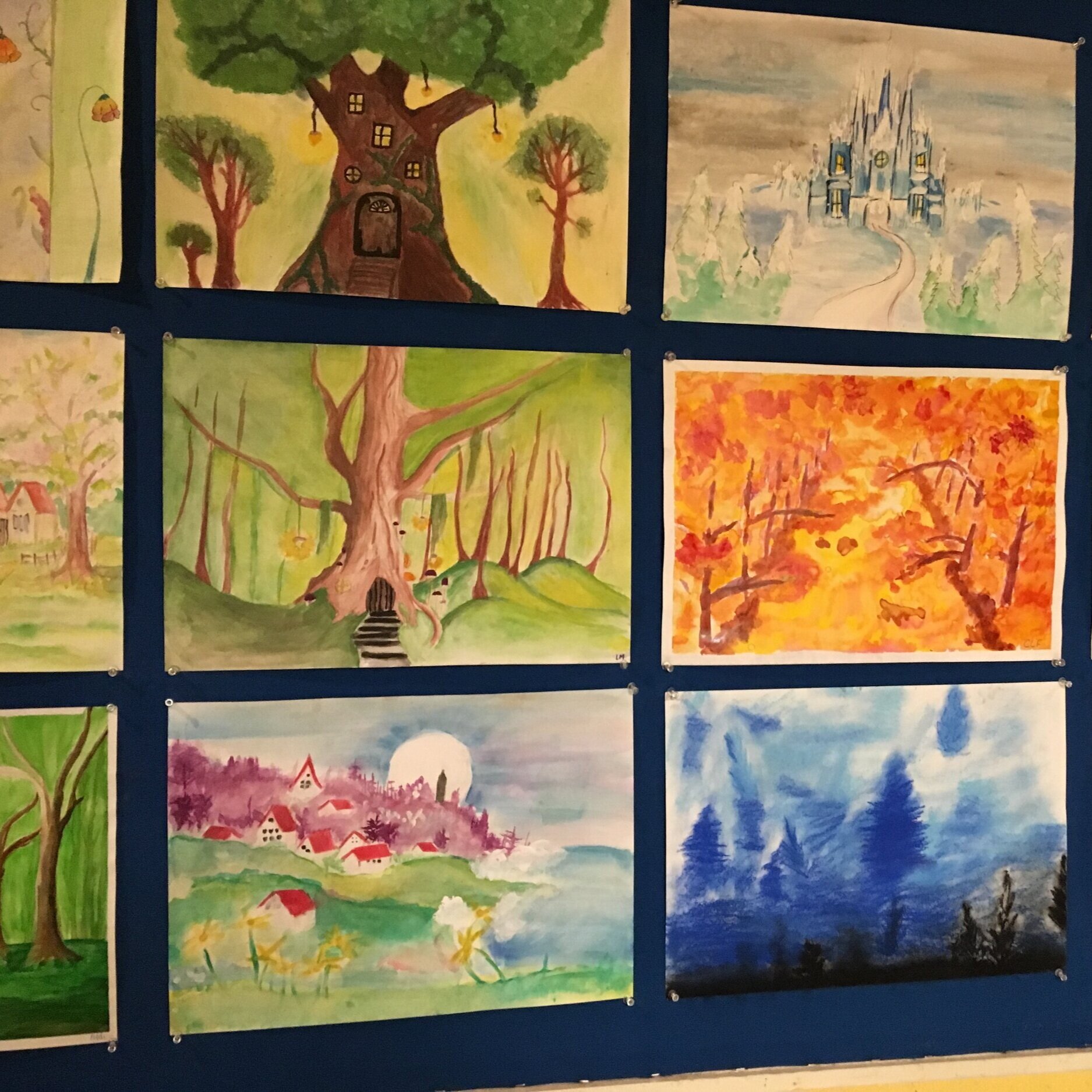
We’ve reached the letter ‘P’ in our 26-part series on what makes a Madrona School education unique, and P is for painting. Art infuses our curriculum, and a basic tenet of Waldorf education confirms artistic expression as elemental to our humanity. Every one of us is an artist, a creative being. In addition to drawing in main lesson and other specialty periods at Madrona, we include watercolor painting as a weekly activity in our early childhood classes, as well as a specialty class throughout the grade school. Our students learn techniques around wet-on-wet painting, applying watercolors to wet paper. This technique demonstrates the fluidity of color and requires time to learn, so the children build on what they know as they move through the grades. And, as with much of our curriculum, the full flowering of painting technique reveals itself in the middle school years. In kindergarten and 1st grade, students learn to work with color, experiencing colors both separately and blended, and they also begin to acquire brush control. As they develop skills, paintings reflect current main lesson blocks, and augment main lesson drawings and essays, becoming more detailed and skilled as they master techniques. We invite you to walk through the school building every so often - the teachers hang art in the halls on a regular basis. It's inspiring!

— adapted from our school newsletter

Madrona School Alphabet (O)

Hand drawn world maps by our 2019 8th graders — done as a part of their economic geography block.

We’re into the second half of our alphabet highlighting what makes a Madrona School education unique! ‘O’ celebrates Waldorf education as a part of our larger world. Madrona School, as a developing Waldorf school, is a member of a worldwide and growing independent education movement celebrating 100 years in 2019. According to the latest figures, there are more than 1,100 Waldorf schools in more than 60 countries; if you look specifically at early childhood programs, there are more than 2,000 on five continents. 

Waldorf education originated in Germany in 1919, when a factory owner asked Rudolf Steiner to develop a school for his workers' children. The original co-educational school, open to all and administered by teachers, was a direct outgrowth of Germany's social renewal efforts following World War I. And, even though the Waldorf education movement began in one place at a specific time, it continues to grow and evolve, seeking always to educate the whole child, recognizing a child reaches his or her full potential when education addresses not only the mind, but the body and spirit as well. Today, each Waldorf school is independently run, and each school reflects local culture and practice -- just as we make use of all the natural beauty in our local woods and beaches and incorporate our region's history and culture into our curriculum, the same is true for schools around the world. At the same time there are elements of Waldorf education that are recognizable and translate across cultures, as each and every school strives to educate and develop each student's awakening capacities, and graduate creative thinkers who feel themselves a part of not only their culture, but of a common humanity.

Postcards received as a part of the global postcard exchange between Waldorf schools in 2018-2019.

Postcards received as a part of the global postcard exchange between Waldorf schools in 2018-2019.

If you are interested in reading more, please investigate the information on the AWSNA (Association of Waldorf Schools of North America) website, or all of the work that the German organization, Friends of Waldorf, highlights on their webpages. And, for a visual trip around the world, check out the Waldorf100 videos: Learn to Change the World, and the early childhood focused, Becoming. It is so interesting to see snippets of so many schools in so many different cultures! 

In the day to day work of educating our students, we don't often think of our little school on Bainbridge Island with global connections, but indeed they are there!

—adapted from our school newsletter