Madrona School's Alphabet (C)

Our amazing class teachers are at the heart of Madrona School!

In our mixed-age preschool and kindergarten classes, a young child can expect to have one teacher for the duration of the program, sometimes over multiple years. This continuity of care is comforting to the young child, and it means that when it is time for grade school, the teacher is able to offer a full developmental picture to the incoming 1st grade teacher.

In the grade school, the class teacher loops up each grade with his or her class through the 8th grade. While not necessarily unique to Waldorf education, "looping" teachers are relatively rare in American schools. A class teacher has been a fixture of the Waldorf grade school since Rudolf Steiner founded the first school in Germany at the close of the first world war, however. Steiner believed that the strong relationship forged between a teacher and a student was essential to a robust education and healthy child development. Students in a Waldorf grade school begin each day and have main lesson with their class teacher, who becomes a familiar and beloved part of their school lives, even while they have a chance to learn from other teachers throughout the day in specialty classes. When a teacher spends this much time with his or her class, the education is truly child-centered, allowing a teacher to bring developmentally appropriate and emotionally engaging education to a constellation of students. Teachers and students build long-term relationships, and a teacher can truly foster community building within a class. It is the essential work of the teacher to know and see each student and to meet them where they are in any given year of their development -- no small task, but beautiful to witness as a parent of any grade schooler could tell you!

--edited from our weekly school newsletter, September 17, 2013 and April 28, 2014.

Parent Enrichment with Susanna Reynolds

We are so pleased to welcome Susanna Reynolds back for her second of three workshops this school year. All interested adults are welcome to join us in the 3rd grade classroom on Thursday, November 5 at 6:30pm. Susanna's workshop, entitled, "Seeing our Children in the Dark and in the Light: Becoming More Comfortable With The Polarities of Growth With Your Unique Child(ren)."

Susanna will work with us in conversation and with art to explore the struggling steps and triumphs in grade school children's growing minds and bodies, even as we celebrate their colorful expression and feeling lifes. When we become more comfortable with the fluctuating steps that occur in growth, with can better weather constant change.

Susanna is the Director of Sound Circle Center’s Parenting Programs, and in private practice at Seattle Sensory and Structural Integration. We are always pleased to host her across the water!

Madrona School's Alphabet (B)

What makes a Madrona School education unique and special?
During the 2013-2014 school year, we celebrated what a Waldorf education offers both our children and our community as we strive to graduate creative and eager lifelong learners. Using the alphabet gave us 26 aspects to celebrate! 

B is for...Bread Day! Why do we bake bread in our early childhood classrooms? The obvious answer is because it tastes amazing and fills our hungry young students with a warm, nutritious snack. Yet, the process offers so many benefits, eliciting a robust sensory experience, even as it provides an anchoring weekly rhythm in the early childhood classroom. The activity of baking bread engages the sense of touch through kneading and shaping the silky dough, it engages the sense of smell as the bread bakes, it engages the ears though the songs sung throughout shaping ("Five hot buns in the bakery shop...."), and it enhances class community as the children come together to shape their buns and to eat them warm from the oven. Baking bread also provides an outlet for the purposeful work that young children crave, an activity that they can easily see and participate in from start to finish over the course of a morning. And of course, it is fun and imaginative; sometimes dough gets shaped into worms, bugs or as some grade school students fondly remember, bunnies, hearts or a plate (more room to spread on butter and jam!). 

We all look forward to 'Bread Day' at school. Some children routinely save a bit for a sibling or a parent, spreading the anticipation. And, ask any of our older students, and they will tell you their fond memories of  kindergarten bread. Each year, our older students (and frankly, many teachers) make it their business to know which days are bread days, and they might peek in at lunch, hoping for leftovers. It becomes very nostalgic, and offers a real reminder of the beginning of their respective school journeys. There is a lot baked into each week's bread!

Want to bake at home? Here is a copy of one of the recipes used in our preschool and kindergarten classrooms.

--reprinted from the weekly school newsletter, September 23, 2014.

The Madrona School Annual Fund for 2015-2016

Jump In!

BIL_6649.jpg

Our annual fund for the 2015-2016 school year is underway, and will run through mid-December. Our goal this season is a short and sweet $50,000 in 50 days. As in other years we're aiming for 100% parent community participation, at whatever level feels comfortable for your family. 

The annual fund supports the current year's operating budget, allowing us to continue to provide a joyful and creative education to around 130 students. Furthermore, the Madrona School board is in the first of a three-year effort to raise teacher salaries to be commensurate with island public and independent schools.

New this year!: Give directly through the Madrona School website -- it's quick and easy to give either a one-time or a monthly gift. Gifts can be processed through your bank account, or your debit or credit card. And, all your family and friends can give this way too.

We are so grateful for your gifts -- at any amount. Thank you for supporting Madrona School and Waldorf education!

Madrona School's Alphabet (A)

What makes a Madrona School education unique and special?
During the 2013-2014 school year, we celebrated what a Waldorf education offers both our children and our community as we strive to graduate creative and eager lifelong learners. Using the alphabet gave us 26 aspects to celebrate! 

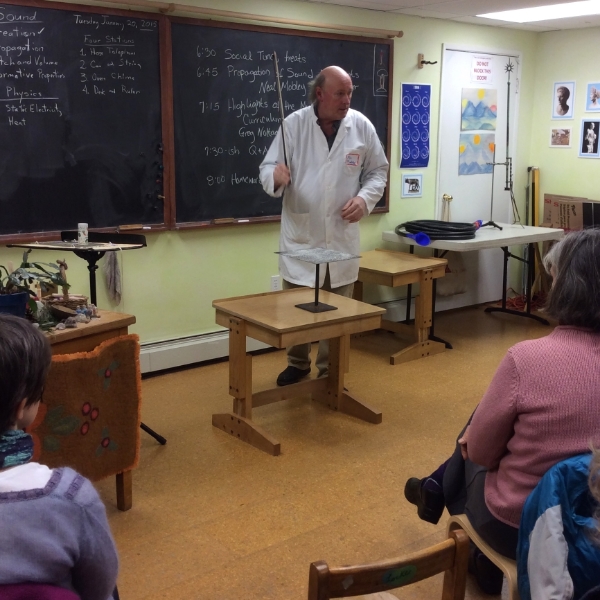
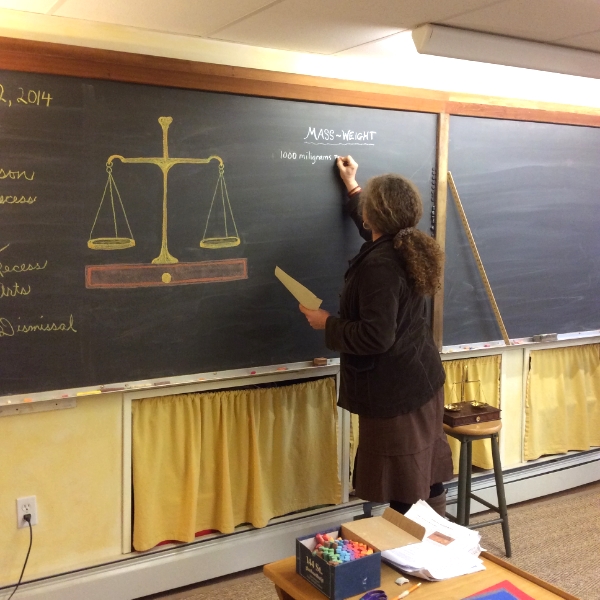
A is for...Academics--academics infused with art, with movement, with music, with attention to social well-being, and through hands-on activities. At Madrona School, we enrich the teaching of reading, writing, science and math in a myriad of ways.  The goal of a Waldorf school is to educate the whole child, graduating students who become balanced, curious and creative adults.  One of the ways that we accomplish this is to bring academic material to the children in a way that meets their developmental needs.  In the early grades, children are strongly compelled by their emotional life: that is, if they feel love, joy and excitement about what they are doing, they remember it well.  As they mature, their thinking capacities grow, and presenting material in an intellectually invigorating way captures the imagination of middle school students.  Our students are taught to employ all of themselves to their lessons: their artistic, physical, intellectual, and writing capacities are engaged on a daily basis; cultural stories and history from around the world offer ongoing lessons in our common humanity. Thus we offer a rigorous, engaging curriculum that changes over time to prepare students, developing their capacities, not only for high school and further schooling, but also for life. 

A couple of examples: In second grade, our students work on math facts including the multiplication tables. They do study, memorize and are "tested" on them, but they also chant and clap them in different rhythms, and draw them into patterns in their lesson books. This "body-based" learning and memorizing is where the whole child is engaged, and ensures that these foundational facts are well in hand. In middle school math then, they are able to re-do multiplication tables in different bases, pushing their understanding of number sense.

In the sciences, a student's developing capacity for observation begins in early childhood through the simple awareness of the changing seasons. In early grade school, basic experiments such as the sprouting of a seed, charting the growth of a field of wheat or a pumpkin on a vine, hone a student's attention to detail. Once a student reaches middle school, an awakening capacity for independent thought offers the ability to observe experiments in chemistry and physics and to extrapolate and reach conclusions with fellow students and the guidance of their teacher; these observations and learnings are recorded in precise and beautiful detail in their main lesson books.

--edited from our weekly school newsletter, January 28, 2014.

Learn more about Madrona School by scheduling a tour; additional information on Waldorf education is available here.

Experience Waldorf!

Join us on Thursday, October 15 at 6:30pm for a chance to experience mini-lessons with some of our grade school teachers. We'll meet in our mixed-age kindergarten classroom, through the lower archway just off the north parking lot at the Eagle Harbor Congregational Church. Please park in the gravel portion only of the parking lot.

Specifically, we'll visit the 1st grade classroom to see how we approach teaching reading; we'll go to 3rd grade for a mini-Spanish lesson and hear about world language instruction in the grades; we'll visit 5th grade for a painting technique lesson; and, finally, sit down in 6th grade for a lesson in geometric construction. 

All interested adults are welcome at this glimpse into a Waldorf classroom, and a chance to see how some of our teachers deliver joyful and creative education to our 90+ grade school students each day.

Contact the office for additional information: 206-855-8041.

From the Classroom: 7th Grade

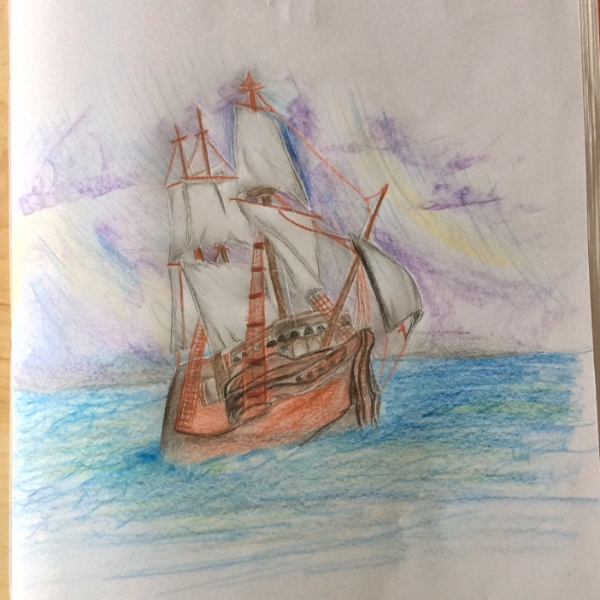
Our 7th graders began their new year with a block on the Age of Exploration. Ms. Stanley, our 7th grade teacher, recently wrote to her class parents: "The Renaissance voyages of discovery rank as one of history's two or three most important phenomena in terms of their effect on the modern world. In roughly two centuries, from about 1420 to 1620, the world changed completely and forever. A few hundred curious, daring, imaginative, reckless and determined men redrew the map of the world. They changed the world's eating habits; they caused the downfall of civilizations and contributed to the rise of others; they pushed forward the sciences of map making and navigation; and they put their European stamp on two entire continents. Exploration and discovery go on all the time, but the 15th and 16th centuries are known as the age of exploration because of the dramatic burst of activity that resulted in nearly quadrupling the known extent of the world.

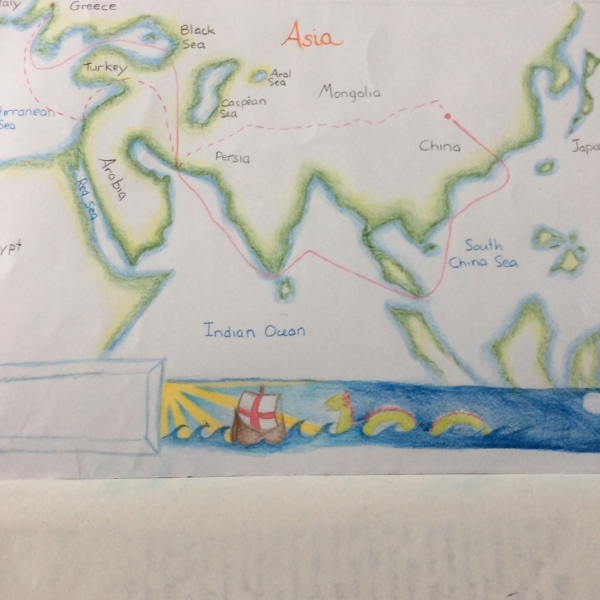
In this block we have studied Marco Polo who was the first person to travel the entire length of the Silk Road in 1271. The fantastic stories he brought back about Kublai Khan's empire fueled the desire of Europeans to reach China by an easier means than the year long journey across the continent.
 
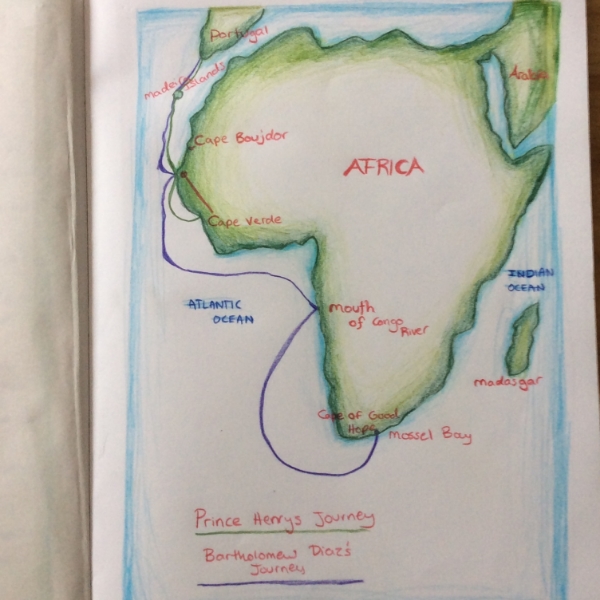
We learned about Prince Henry of Portugal, who set up an observatory from which he conceived, planned, and organized expeditions along the west coast of Africa. He is also known as Henry the Navigator although he never left home himself. It was another Portuguese, Bartolomeu Dias who, blown about by a violent storm, was the first to pass the Cape of Good Hope....

Of course we did not forget Ferdinand Magellan who circumnavigated the globe in a gruesome journey of three years.

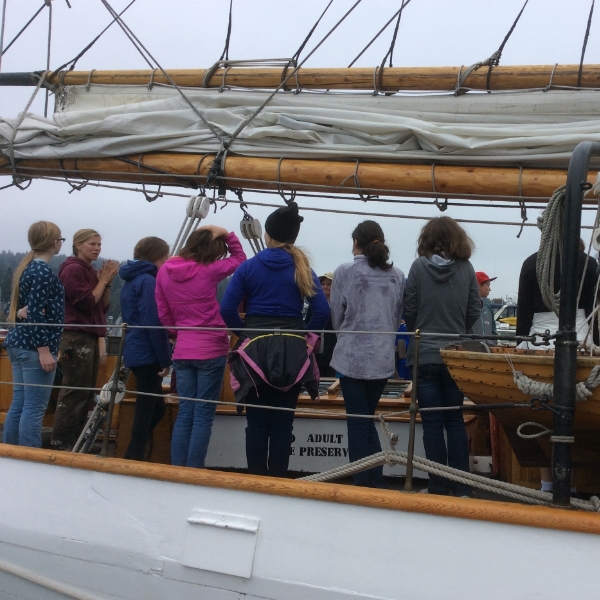
This block ended with our own amazing sailing trip on the Adventuress in the Puget Sound."

--edited from the weekly school newsletter, October 6, 2015