Exploring Waldorf

Blacksmithing in 3rd Grade

There is so much "doing" in the practical life curriculum in a Waldorf school 3rd grade, and this year's class has baked, constructed, crocheted, dyed, harvested, hatched, planted, preserved, spun, threshed, etc. Today they spent main lesson out on the play yard forging with local blacksmith, Jeremy Loerch of Alchemy Industrial Arts. Each student made a coat hook: heating, hammering, bending and twisting the metal into shape. You could hear the ring of the hammer around the school building, and at recess time the taped off area around the portable forge was a draw for everyone.

Photos show: hammering and flattening the tip of the hook; shaping the hook; a demonstration of twisting for decoration; while groups of 4 worked at the forge, the rest of the class recorded their observations with both words and drawings.

The Benefits of Eurythmy...

We have one more adult eurythmy class this year with our visiting eurythmist, Audun Smit. The class is open to all this Friday at 9am in the EHCC Fellowship Hall. The following thoughts on eurythmy are offered by one of our founding parents and teachers, and were originally published in our weekly school newsletter on March 1, 2016.

Eurythmy- Nurture Your Own Heart and Soul

eurythmy.jpg

One of the most helpful things we can do for our children is to nurture our own hearts and souls. When, I’m calmer, my children are calmer. When I’m content, my children are content. Children reflect much of what they experience with the adults around them. And for the next 3 weeks we now have an incredible opportunity to nurture ourselves right here at Madrona- in a free adult eurythmy class.

The word eurythmy stems from the Greek roots for beautiful or harmonious rhythm. A dictionary may define eurythmy as a system of harmonious body movement to the rhythm of spoken words. But it is much more. Eurythmy is an art form created by Rudolf Steiner. And in a slightly modified form it can be appliedtherapeutically. Rudolf Steiner’s essential point is that eurythmy is visible speech, visible music. He described it as “art of the soul”. One can even go further and maintain that the movements of eurythmy do actually proceed out of the inner movements of the organization of man. That said, as you can see, it’s very hard to describe eurythmy in words; it really needs to be experienced.

I’m not a eurythmist, but I’ll share with you how I feel after finishing an adult eurythmy class. I feel calm, centered, and uplifted yet grounded. I feel a greater sense of connection- connection to a grander Source, to the others in the eurythmy circle, to the earth, and to myself. I feel pure joy! Wow- all in one hour!  Another added bonus- it’s just plain fun!

A bit of history that you may not be aware of is that Madrona School was seeded in eurythmy (and festivals). Prior to the start of the school, we were blessed with David Michael Monasch, a eurythmist from Seattle, coming to Bainbridge every week to teach eurythmy. We experienced the gift of community literally moving together as One during eurythmy class and I believe that those years of relating in this nonverbal way helped set the foundation for a healthy school to be co-founded.

Now we’re blessed with another amazingeurythmy teacher, Audun Smit .  I experience Audun’s presence as pure and clear. He exemplifies both groundedness and radiance. Before I learned his name, I found myself calling him “the Angelic Eurythmy teacher”. So even if you’re not so interested in eurythmy, it may be worth coming just to be in his presence.

I hope to see you in adult eurythmy class Friday mornings March 4, 11, 18 from 9:00-10:00. Actually I wish all parents could experience this simple, yet profound practice. After all, parenting isn’t always easy and we could all use a bit of nurturing for our own hearts and souls.

With deep gratitude,
Debby Haase
Former Madrona teacher of Grades 1-8
Parent of two Madrona graduates
Co-founder of Madrona

Madrona School Alphabet (E)

As we continue to celebrate what makes a Madrona School education unique through the alphabet, we have reached the letter 'E' ... and Eurythmy!

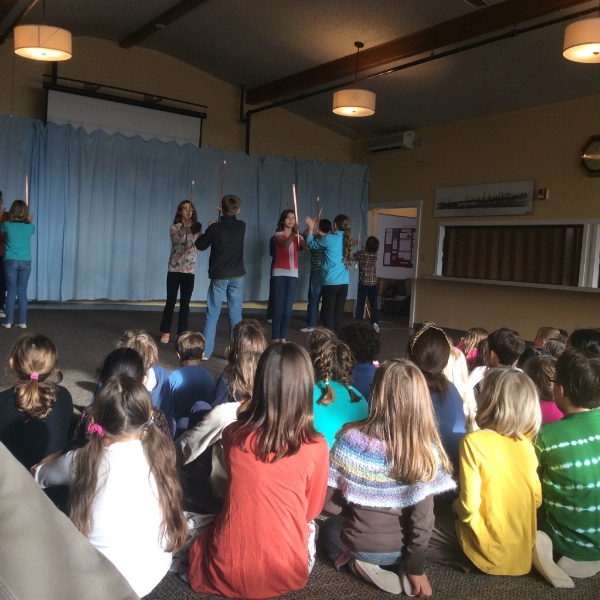
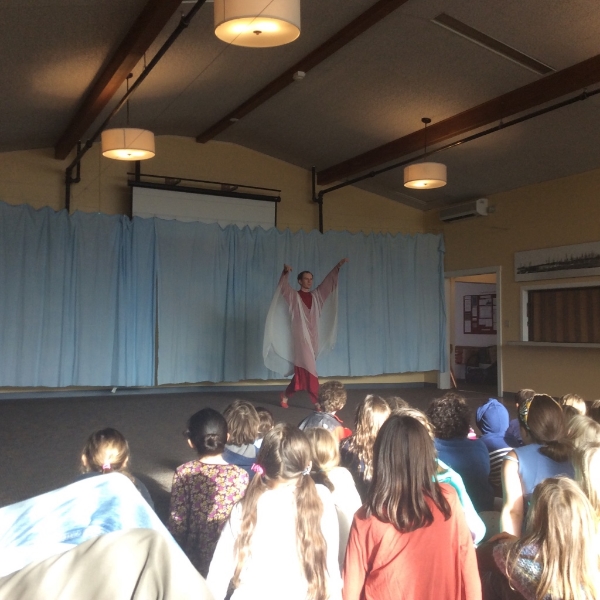
We just wrapped up a six-week block with visiting eurythmist, Audun Smit. Mr. Smit offered classes to our kindergartens and our grade school, as well as weekly opportunities for adults and at the opening of our faculty meetings. It was a true gift to our community!

Eurthymy is an art form from Rudolf Steiner based on movement, and making music and tone visible through that movement. Beautiful to watch and to do, it has elements of dance, sculpture and creative expression. Here at Madrona School, we offer eurythmy in blocks as we are able, providing some exposure for our students to this essential aspect of the Waldorf curriculum.

Movement in all its forms is so essential to learning, and Waldorf education emphasizes it throughout the curriculum. When we move, we learn -- coordination, problem solving, working effectively with others, etc. In our early childhood programs, children practice integration of movement, both gross and fine motor, in order to prepare themselves for their academic journeys ahead. And in grade school, movement continues to be critical for a greater integration of academic material, as well as practice for those all important social skills.  

And eurythmy is movement like nothing else we offer, with live piano accompaniment and uplifting verse. Truly a gift for each child, even as they work on spatial awareness and social integration, expressing themselves from the inside out. 

-- edited in part from the school newsletter, November 19, 2013

Madrona School Alphabet (D)

What makes a Madrona School education unique and special?
During the 2013-2014 school year, we celebrated what a Waldorf education offers both our children and our community as we strive to graduate creative and eager lifelong learners. Using the alphabet gave us 26 aspects to celebrate! 

D is for Drama! We enjoy good drama (of a certain kind!) at Madrona School. In our early childhood programs, we nurture imaginative play acting each and every day. And, each grade school class puts on a play every year.  From the simplest beginnings in 1st grade, to full blown productions in 7th and 8th, our students learn to be comfortable performing on a stage. They memorize lines, work together on sets and staging, speak clearly and with passion, sing and make music. Drama enhances literacy, creativity, self-confidence, flexibility -- and it's fun!

-- edited from our school newsletter on October 1, 2013

Parent Enrichment with Susanna Reynolds

We are so pleased to welcome Susanna Reynolds back for her second of three workshops this school year. All interested adults are welcome to join us in the 3rd grade classroom on Thursday, November 5 at 6:30pm. Susanna's workshop, entitled, "Seeing our Children in the Dark and in the Light: Becoming More Comfortable With The Polarities of Growth With Your Unique Child(ren)."

Susanna will work with us in conversation and with art to explore the struggling steps and triumphs in grade school children's growing minds and bodies, even as we celebrate their colorful expression and feeling lifes. When we become more comfortable with the fluctuating steps that occur in growth, with can better weather constant change.

Susanna is the Director of Sound Circle Center’s Parenting Programs, and in private practice at Seattle Sensory and Structural Integration. We are always pleased to host her across the water!

Madrona School's Alphabet (B)

What makes a Madrona School education unique and special?
During the 2013-2014 school year, we celebrated what a Waldorf education offers both our children and our community as we strive to graduate creative and eager lifelong learners. Using the alphabet gave us 26 aspects to celebrate! 

B is for...Bread Day! Why do we bake bread in our early childhood classrooms? The obvious answer is because it tastes amazing and fills our hungry young students with a warm, nutritious snack. Yet, the process offers so many benefits, eliciting a robust sensory experience, even as it provides an anchoring weekly rhythm in the early childhood classroom. The activity of baking bread engages the sense of touch through kneading and shaping the silky dough, it engages the sense of smell as the bread bakes, it engages the ears though the songs sung throughout shaping ("Five hot buns in the bakery shop...."), and it enhances class community as the children come together to shape their buns and to eat them warm from the oven. Baking bread also provides an outlet for the purposeful work that young children crave, an activity that they can easily see and participate in from start to finish over the course of a morning. And of course, it is fun and imaginative; sometimes dough gets shaped into worms, bugs or as some grade school students fondly remember, bunnies, hearts or a plate (more room to spread on butter and jam!). 

We all look forward to 'Bread Day' at school. Some children routinely save a bit for a sibling or a parent, spreading the anticipation. And, ask any of our older students, and they will tell you their fond memories of  kindergarten bread. Each year, our older students (and frankly, many teachers) make it their business to know which days are bread days, and they might peek in at lunch, hoping for leftovers. It becomes very nostalgic, and offers a real reminder of the beginning of their respective school journeys. There is a lot baked into each week's bread!

Want to bake at home? Here is a copy of one of the recipes used in our preschool and kindergarten classrooms.

--reprinted from the weekly school newsletter, September 23, 2014.

Madrona School's Alphabet (A)

What makes a Madrona School education unique and special?
During the 2013-2014 school year, we celebrated what a Waldorf education offers both our children and our community as we strive to graduate creative and eager lifelong learners. Using the alphabet gave us 26 aspects to celebrate! 

A is for...Academics--academics infused with art, with movement, with music, with attention to social well-being, and through hands-on activities. At Madrona School, we enrich the teaching of reading, writing, science and math in a myriad of ways.  The goal of a Waldorf school is to educate the whole child, graduating students who become balanced, curious and creative adults.  One of the ways that we accomplish this is to bring academic material to the children in a way that meets their developmental needs.  In the early grades, children are strongly compelled by their emotional life: that is, if they feel love, joy and excitement about what they are doing, they remember it well.  As they mature, their thinking capacities grow, and presenting material in an intellectually invigorating way captures the imagination of middle school students.  Our students are taught to employ all of themselves to their lessons: their artistic, physical, intellectual, and writing capacities are engaged on a daily basis; cultural stories and history from around the world offer ongoing lessons in our common humanity. Thus we offer a rigorous, engaging curriculum that changes over time to prepare students, developing their capacities, not only for high school and further schooling, but also for life. 

A couple of examples: In second grade, our students work on math facts including the multiplication tables. They do study, memorize and are "tested" on them, but they also chant and clap them in different rhythms, and draw them into patterns in their lesson books. This "body-based" learning and memorizing is where the whole child is engaged, and ensures that these foundational facts are well in hand. In middle school math then, they are able to re-do multiplication tables in different bases, pushing their understanding of number sense.

In the sciences, a student's developing capacity for observation begins in early childhood through the simple awareness of the changing seasons. In early grade school, basic experiments such as the sprouting of a seed, charting the growth of a field of wheat or a pumpkin on a vine, hone a student's attention to detail. Once a student reaches middle school, an awakening capacity for independent thought offers the ability to observe experiments in chemistry and physics and to extrapolate and reach conclusions with fellow students and the guidance of their teacher; these observations and learnings are recorded in precise and beautiful detail in their main lesson books.

--edited from our weekly school newsletter, January 28, 2014.

Learn more about Madrona School by scheduling a tour; additional information on Waldorf education is available here.