

Exploring Waldorf

Season of Strength - The Michaelic Impulse

St. Michael - Slaying the Dragon (Student Painting)

By Isaac Kemsley, Madrona School Kindergarten Teacher

The changing seasonal cycles are celebrated in Waldorf Schools all over the world. The rhythms of the year reverberate through the minerals, plants, animals and humankind that make up the natural world. In all of the kingdoms, the cycles are felt and followed: expansive growth and hibernative contraction. Only humans have found ways to distance themselves from the earth’s natural cycles through their own rhythms of work and school calendars, alarm clocks, electric lights, and disrupted sleep patterns. It almost seems that humans refuse to acknowledge that they belong to the earth.

However, if we were to examine the patterns of of the year more closely, we would see that the human impulse to push against the riotous blossoming of the summer plants, engorged fall fattening of the animal world, and the retreating into hibernation of all the other kingdoms through the winter… is itself a natural rhythm. For what would humanity be if it were to succumb to the dreamy, heady intoxication of the midsummer months? How would mankind function if we were to crystalize into the deep sleep of winter’s slumber?

No, humankind’s job is found in the challenging work of remaining aware of the natural cycles that tug and pull upon us and still utilizing our will to remain conscious of the task at hand. We are both gifted and cursed by the knowledge that does not allow us to remain in the Garden, but instead allows us to fulfill a higher purpose in self-cognition.

So as the season shifts from the buoyancy of summer into the grounding of fall, we can reflect on the changes we see around us. The turning of the leaves, the harvest of the fruits and vegetables of the gardens, the fattening squirrels frantically filling their stores, the shorter days and longer nights, all of these signs remind us that soon the warmth of the sun will not provide the heat and light to sustain us. Instead, humans must steel themselves, fortify our strength and courage to face the death and decay of the world around us and carry on driven purely by our will forces into the darkness of the winter months.

In Waldorf Schools, the Harvest Festival or Michaelmas Festival, is the fall festival to mark that change of seasons. Coming together in community to eat and drink and to test ourselves in games of bravery and strength is a chance to acknowledge that we are preparing for the shift into coldness and darkness. It is a bolstering of oneself and each other in a celebration of humankind’s unique position in the natural world.

The Archangel Michael has historically been the patron of this festival as he symbolically tames the dragon in legend. The dragon can stand for any of the challenges that stand before us. I like to imagine that the dragon is our lower nature that pulls us toward forgetting our place in the delicate balance between humanity and nature. The striving nature of humanity can lead to hubris if left unchecked. That desire to divorce ourselves from the natural cycles can lead us down the road that we find ourselves on currently. One where we let machines make many of our decisions for us. It is the other extreme from the dreamlike state that we emerged from when we first became conscious of our self-awareness, separate from the other kingdoms.Yet it similarly threatens to steal our cognitive autonomy.

I imagine that St. Michael, with his shining sword and red cape, represents our highest nature. The red blood that makes up our circulatory system, and the shining sword that represents the upright spine and nervous system that sets us apart from the other animals on earth. This combination of physical attributes help create in each of us the tree of knowledge, that allows us to recognize, appreciate, and act on the unique position that humankind holds in this world.

It is a balancing act that we perform in this lifetime. To fulfil a higher purpose, to better ourselves, to leave this earth/plants/animals/people better off for having known us than if they hadn’t. It is a life of striving and I don’t know if it is often fulfilled just as we intended… but I do know that it takes an awful lot of courage to try.

Introspection on Connection

By Isaac Kemsley, Madrona School Kindergarten Teacher

Working with young children for the past several decades has shown me the importance of sincere reflection upon how I present myself. As a teacher and as a parent, the children in my care have taught me that my actions often carry more weight than my words.

Children in their early years learn from observation and imitation. They are watching the adults in their lives for non-verbal cues to see what is acceptable and worthwhile in our culture. A child learns how to behave not only from the classroom, but constantly throughout the day from a myriad of environments: home, car, grocery store, playground, etc.

This natural sponge-like absorption of the world around the young child allows them to grow at a rapid rate in their early years, absorbing language, social norms, and behavioral expectations. It also pushes the adult responsibility of self-reflection to the forefront of the parenting tool chest.

I am challenged every day, as a teacher and as a parent, to display thoughtful actions that are worthy of emulation. It can be a difficult, daunting task. At times I may come up short and I try to be forgiving of my shortcomings. But I owe it to myself, the children in my care, and to society as a whole to continue trying to improve every day.

You can approach parenting as a path to your own personal growth. Consider mentally picturing your children as YOUR teachers, who are here to show you the areas in yourself that you could reflect upon and perhaps evolve over time.

Are we modeling the common courtesies that we hope that our children will grow into?

It can be as simple as giving your child a moment of sincere engagement when saying goodbye in the morning. Some physical expression of your affection, a verbal reminder of who will be picking them up after school, and the firm inner conviction that they will be well cared for and emotionally successful in their day; these actions will buoy them through the gate into the new waters of each day.

It is also important to model healthy boundaries for your child when you are talking to another adult or engaging with a sibling. Making it clear (even with just a gesture) that you will listen to them after you finish your current conversation demonstrates respect for others, models active listening, and exercises the child’s patience by asking them to wait their turn.

At times when it is important to give your child your undivided attention, like pickup in the afternoon, you can put away your phone and wrap up your adult conversation before greeting your child. Drop down to their level, look them in the eyes, give them your whole attention and hear what they have to share with you. This will show them that their experience matters. It models for them the listening skills that we hope they will develop in their lifetime.

Of course, these approaches are not always possible, and that, too, is alright. If the children regularly see that direct, meaningful connections are important to us, those connections will remain important to them.

Modeling Real Work in the Kindergarten

By Isaac Kemsley, Madrona Kindergarten Teacher

Children before the age of seven learn much of their foundational skills from imitating the adults in their environment. The young child is a being of the senses; absorbing the sights, smells, sounds, and tactile sensations of their immediate surroundings. They build upon those sensory inputs, through the regular practice and imitation of what they observe.

Language is learned this way, from infancy onward. Gross and fine motor skills are likewise developed from following the lead of those surrounding them. Crawling, then walking, are pursued to achieve locomotion like their siblings and parents. Hand-eye coordination begins in infancy and continues through the years, gradually sharpening to a finely measurable point in adulthood.

Sometimes, we can mistake this inborn drive to imitate skill building, as early readiness. Reading, computing, and other adult activities are seen as worthy of emulation by the young child because they are of importance to the adults in their lives. However, we would never allow our children to drive an airplane or garbage truck because they are enthralled by the power invested in those activities. First they must develop the foundational skills that precede those adult activities.

That is why Waldorf Early Childhood Teachers make a conscious effort to model work that is important to skill building in the young child, that has at least an element that can be taken up by them beside the teacher as they move through the day. Cooking, cleaning, preparing our activities and space, tidying, mending and repairing, all of these activities are made available to the children as we do them throughout our day. The children dabble, in child-sized portions, with trying real work and then quickly translate it into their imaginary play world to process and practice these new skills.

Teacher Jamie cooks each day, including the children in certain stages of her snack preparation. They are able to take part in the washing, peeling, chopping, mixing, kneading, and tasting of our daily dishes. They then take those skills to the mud kitchen to practice and hone their newfound skills, “cooking” for one another.

I tidy and shovel and rake and whittle and create and mend broken toys. When the weather cools, I chop wood and build fires in the fire pit to keep our hands warm. The children join me in these activities to serve the group, creating their own toys and maintaining their environment.

I have witnessed the children shoveling and raking wood chips, splitting firewood, hauling boards to build obstacle courses and shelters of their own, and sawing off portions of a fallen limb to make toys of their own. These are all things that they have observed us engage in during the class day and are all activities that build and strengthen their coordination skills and cooperative relationships.

Proprioceptive Integrative Play

By Isaac Kemsley, Madrona School Salmonberry Kindergarten Teacher

We all know, from our experience as parents, that the young child seeks a variety of sensory stimulation from birth. One of those sensory systems is the proprioceptive system. The proprioceptive system uses a system of proprioceptors (nerve centers located in the muscles, tendons, and joints) to combine with our other sensory systems to create a mental map of our body’s position and movement. It is a crucial part of developing balance, spatial awareness, and fine motor skills (including vocal modulation and volume control).

The kindergarten aged child’s work is, in large part, the development of strong neural pathways linking their sensory systems’ inputs to their brain for processing. That strengthening of pathways happens through repeated practice with a variety of sensory experiences. Everything that the young child does is strengthening (or weakening) these foundational systems that later become automatic abilities that free up energy and attention that is used for more complex learning and development.

Think of the way that we, as adults, can walk, run, drive a car, swing a golf club, or push a grocery cart without having to look at what our hands/feet are doing and without having to use the full focus of our attention. We have developed our proprioceptive sense to spatially map our bodies so that we are able to free up our attention to have a conversation, listen to music, navigate, remember what the par on this hole is, or what we are making for dinner that night.

For the kindergarten aged child, creative free play is a huge part of the healthy exercise of the proprioceptive system. Running, jumping, tumbling, climbing, balancing, pushing/pulling/carrying heavy objects are all examples of play-based stimulation of the nerve bundles in the joints and muscles of the young child. Opportunities for working against physical resistance are valuable experiences for these systems. That is why in the Salmonberry Kindergarten we encourage opportunities for climbing up and jumping down from things, with the frequent building of obstacle courses and onsite climbing structures and trees. There are many heavy wood rounds and boards and beams for the children to build with, carrying and pushing/rolling them from one place to another. When on walks, we have hills on which we regularly tumble and roll down.

In addition to free-play opportunities for proprioceptive stimulation, we craft our circle time movements to include a wide range of activities that engage our muscles and joints. Jumping, skipping, hopping, somersaulting, tumbling, “logrolling” and “wheelbarrowing” are just some of the movements we practice during circle time.

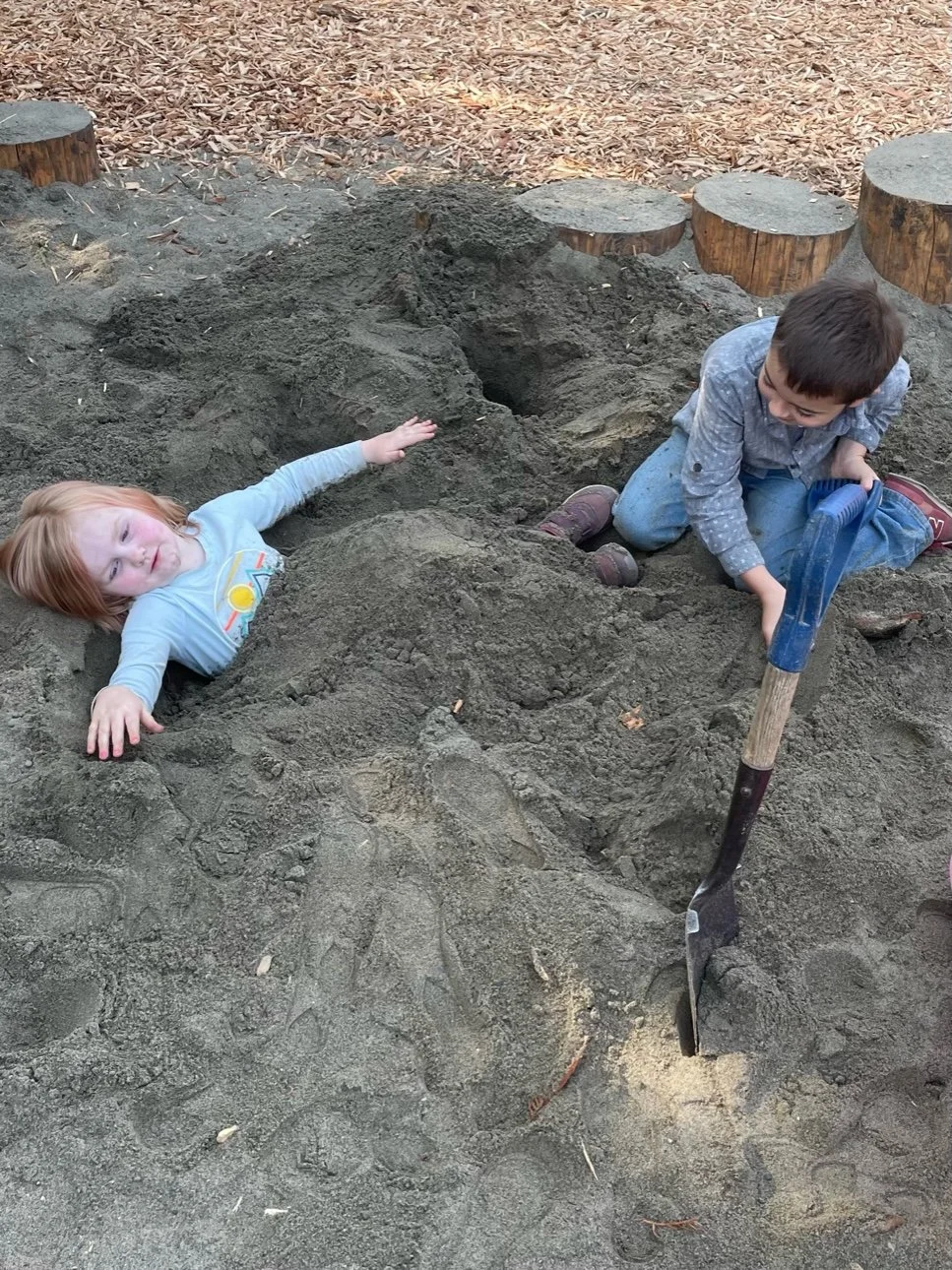
Other times, if a class group is asking for more proprioceptive activities, we will dig holes in the sand boxes and “plant flower gardens” by burying children up to their waists in the heavy sand. This not only activates the nervous system in the upper body through the act of digging a hole, but it also provides compression and activation of the lower body in the burying and then wiggling free.

If a group asks for more gross motor work, we also help facilitate a wrestling circle; either one-on-one between children or in a game of “Brown Bear” with a teacher. The hand to hand grappling of two children pushing against each other, is a full proprioceptive system activation, engaging the whole system in the effort to topple a classmate. In the game “Brown Bear,” the children try to wrestle the teacher to the ground while the teacher crawls on all fours. The children tumble, roll, and pile up upon one another, as they try to topple “Brown Bear.”

Wrestling games such as these, have the added social benefit of raising further boundary awareness, as they are only able to be successful if participants listen for verbal boundaries at the same time as they experience their physical periphery. The developing ability to modulate one’s force and the executive functioning to be able to listen when someone calls for a “STOP” is crucial to one’s sense of self, the feelings of others involved in the game, and developing spatial awareness.

If a child has an underdeveloped proprioceptive system that time in the classroom is not able to address, further games are encouraged at home (or with an Occupational Therapist.) There are a variety of swaddling games that can add compression to playful imaginations, weighted blankets, wrestling, massage, etc… all are ways to further strengthen the developing nervous system. Play is learning… and learning is fun!

Developing the Sense of Tactility: Preparing Children for Lifelong Learning

Developing the Sense of Tactility: Preparing Children for Lifelong Learning

We help our children prepare for a life of learning by helping them develop their tactile sense. We do this by hugging & massaging, playing finger games, giving them bread or play dough to kneed, and exposing their skin to a variety of natural materials. Do you want your kids ready for school? Let them play in the mud.